Overview
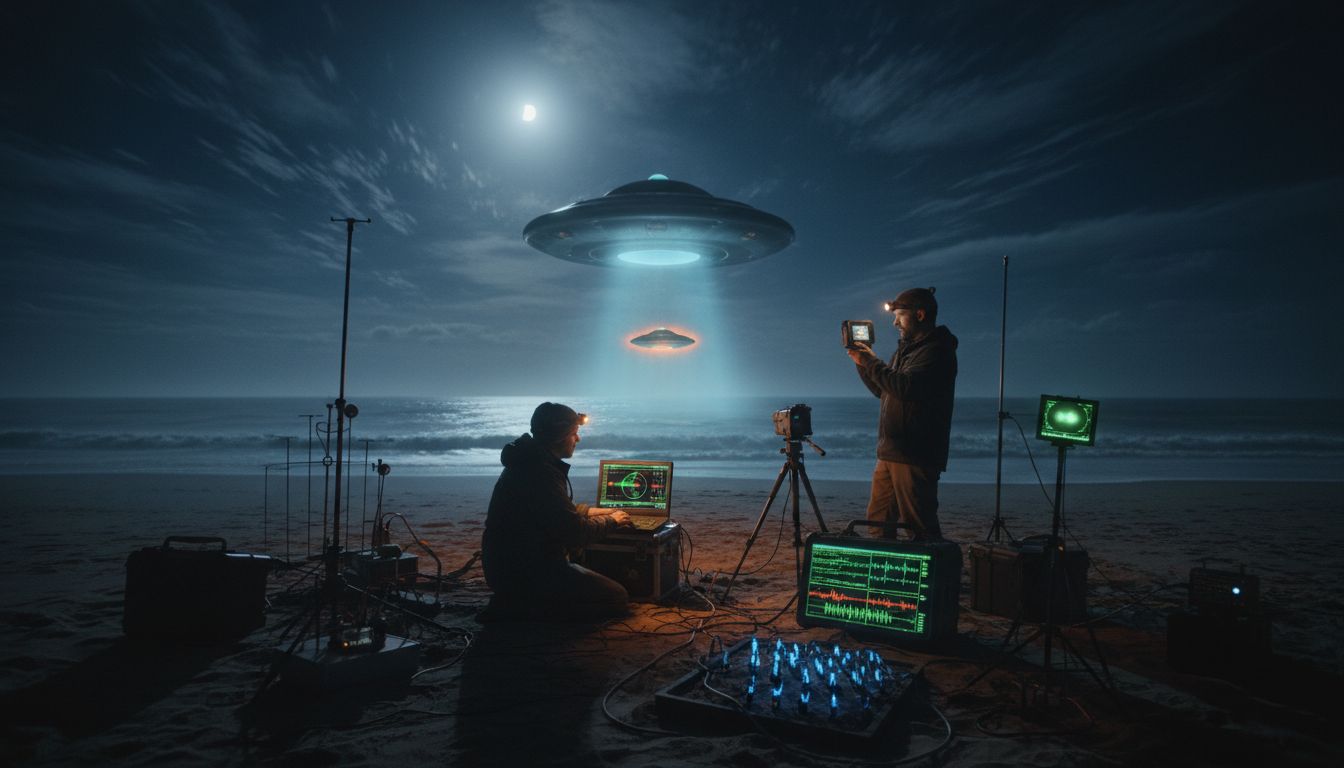
In a recent episode of the UAP Files Podcast, host Jimmy and co‑host Tom Vernon interviewed John and Gerald Tedesco, two independent investigators who have converted a camper‑van into a mobile research lab they call “Nightcrawler: Eye on the Sky.” Operating primarily along the Atlantic coast of Long Island, the brothers use a suite of commercial‑grade sensors to record anomalous aerial activity in real time. The discussion focused on a live beach investigation where radar, infrared (FLIR), night‑vision, radio‑frequency (RF) spectrum analyzers, and magnetic sensors all registered simultaneous, unexplained events. The Tedescos presented the data as a coordinated effort to rule out conventional aircraft, vessels, or atmospheric phenomena.
Methodology and Equipment
The Tedesco brothers detailed a “hyperspectral” detection array that includes two radar units—one X‑band system capable of tracking objects at several miles, a sonar transducer for underwater verification, and a gamma‑ray spectrometer for high‑energy measurements. Imaging is provided by commercial FLIR cameras, ultraviolet lenses, and night‑vision scopes, all mounted on stabilized gimbals. For electromagnetic monitoring they employ broadband RF spectrum analyzers covering frequencies from a few megahertz up to 10 GHz, and a digital compass linked to a Simrad navigation display. Data from these instruments are cross‑checked against ADS‑B flight‑tracking feeds to eliminate known aircraft, and the entire dataset is logged on ruggedized solid‑state drives for post‑mission analysis.
Notable Findings
During the night‑time session the brothers recorded a persistent 3 GHz signal that appeared in lockstep with radar echoes that briefly “blinked” on the screen before vanishing. Gerald Tedesco noted that “this same frequency has shown up in other UAP hotspots, such as Skinwalker Ranch, suggesting a possible common signature.” Visual footage captured small, spherical objects hovering roughly five feet above the sand; using swimmers and wave crests as reference points, the team estimated the objects to be 2–2.5 feet in diameter. The sightings clustered between 11:30 PM and 2:00 AM, a period when commercial traffic from nearby JFK Airport diminishes, a timing pattern the brothers say may indicate a preference for lower electromagnetic “noise” environments.
Magnetic and Power Anomalies
The most striking episode involved a magnetic disturbance recorded while a radar target was tracked at an altitude near 5,000 feet. The digital compass on the Simrad display began to spin erratically and ultimately pointed 180 degrees off‑course. Within seconds a bright pulse of light was observed, after which the van’s onboard generators tripped, forcing the radar and other sensors into standby mode. John Tedesco described the event as “a brief but complete shutdown of our electronic suite, something we have not seen in any conventional test,” emphasizing that the loss of power coincided with the peak of the radar anomaly.
Context and Implications
The Tedescos’ approach exemplifies a growing trend of private citizens applying military‑grade technology to the study of unidentified aerial phenomena. Their systematic use of multimodal sensors and rigorous cross‑referencing of data offers a more objective baseline than anecdotal eyewitness reports alone. While the team stops short of labeling the events as extraterrestrial, they stress that the measurable electromagnetic and magnetic effects merit further scientific scrutiny. Independent verification remains a challenge; however, the detailed logs and raw sensor files released by the brothers provide a foundation for peer review and potential collaboration with academic or government research programs.
Conclusion
The Long Island beach investigation underscores how advanced, affordable instrumentation can capture high‑resolution evidence of aerial anomalies that evade traditional detection methods. By documenting consistent 3 GHz emissions, radar‑only targets, and magnetic disruptions, the Tedesco brothers contribute valuable data points to the broader UAP research community.