Overview
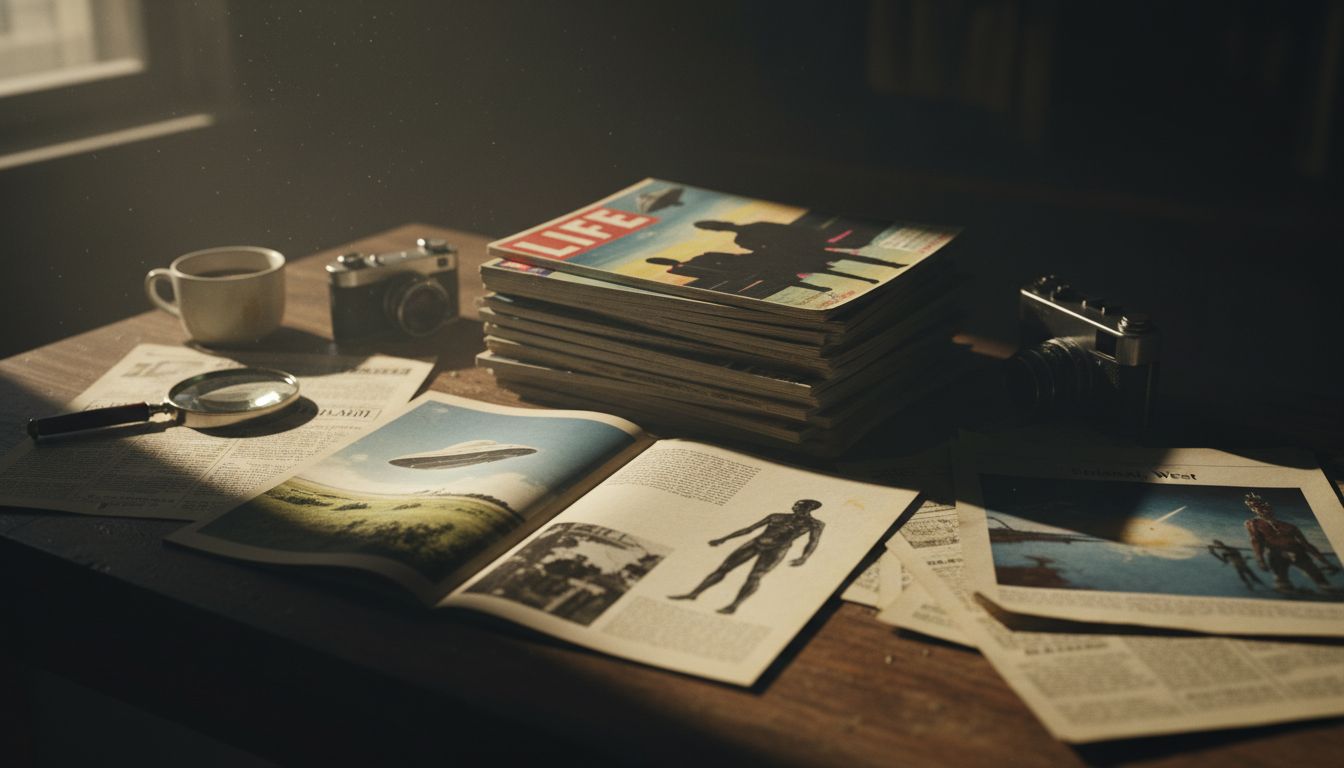
Mainstream media has never fully let go of the UFO story, and LIFE magazine is one of the clearest examples of how a major publication helped shape — and periodically reshaped — public understanding of the subject. In a recent look back at UFO coverage, historian Charles Lear traced how LIFE moved from novelty-driven reporting in the summer of 1947 to more established cultural commentary by the 1960s, while still treating unexplained sightings as a mixture of spectacle, skepticism, and social phenomenon. The magazine’s archived coverage, now preserved in collections such as Archives for the Unexplained, provides a window into how the flying saucer era entered mainstream consciousness almost as soon as it began.
Early Coverage and the Birth of a Media Template
LIFE was among the first national magazines to report on the wave of sightings that followed the 1947 “flying saucer” boom. Its early framing mixed amusement with curiosity, including discussion of fake saucers and questionable eyewitness claims. A July 1947 piece, “Speaking of Pictures… a Rash of Flying Disks Breaks Out Over the U.S.,” noted the frustrating absence of clear photographs — even as it published images of obvious hoaxes, such as a saw blade allegedly struck by lightning and an improvised aluminum disk said to have flown from behind a signboard. That balance of mockery, intrigue, and evidentiary doubt became a durable pattern in UFO reporting.
By 1950, however, the tone had shifted. LIFE ran “Farmer Trent’s Flying Saucer,” focusing on the famous McMinnville, Oregon photographs taken by Paul Trent. The magazine emphasized Trent’s reputation as an honest, frugal man and noted that the negatives showed no apparent tampering, while still leaving room for skepticism. As the article observed, some critics argued the object looked like “the lid of a garbage can.” That blend of cautious credibility and open-ended doubt reflected the magazine’s editorial role as both witness and interpreter of the phenomenon.
From Science Fiction to Official Investigation
In 1951 and 1952, LIFE broadened its approach beyond sightings themselves, linking UFOs to the rising popularity of science fiction and the postwar fascination with space travel. The magazine described science fiction as “the fastest-growing folklore of the machine age,” while also acknowledging the role of pulp culture, film, and fan communities in normalizing extraterrestrial ideas. More importantly, the timing intersected with a major government response: the Air Force’s renewed saucer program, Project Blue Book, under Capt. Edward J. Ruppelt. Ruppelt later wrote that reporters from LIFE visited the office, though the magazine’s stories did not name him or the program directly. The result was a media environment in which UFOs were increasingly treated as a serious public issue, even when the official framework remained vague.
A Legacy Revisited Through Later Cases
The article also points to the way later generations of journalists and writers repeatedly returned to classic cases, including Boianai, Westall, and Robert Taylor’s Scottish encounter. These incidents, though separated by geography and decades, demonstrate how UFO history has become a recurring archive of unresolved testimony. The same pattern appears in renewed coverage of Rendlesham Forest, the long-debunked alien autopsy hoax, and other familiar entries in the canon. Each revival tends to reflect the moment in which it is told: sometimes emphasizing eyewitness credibility, sometimes forensic doubt, and often the cultural appetite for mystery itself.
Cultural Aftermath
Yet the story is not only one of fascination. The darker legacy of UFO culture is embodied by Heaven’s Gate, where apocalyptic belief and extraterrestrial expectation ended in tragedy. That contrast — between serious inquiry, media spectacle, and human vulnerability — is central to why UFO coverage still matters. The history of LIFE magazine’s reporting shows that the public conversation about unidentified objects has always been about more than lights in the sky. It is also a story about how media, belief, and uncertainty interact, and how a single cultural mystery can evolve from tabloid curiosity into a lasting part of modern history.