Overview
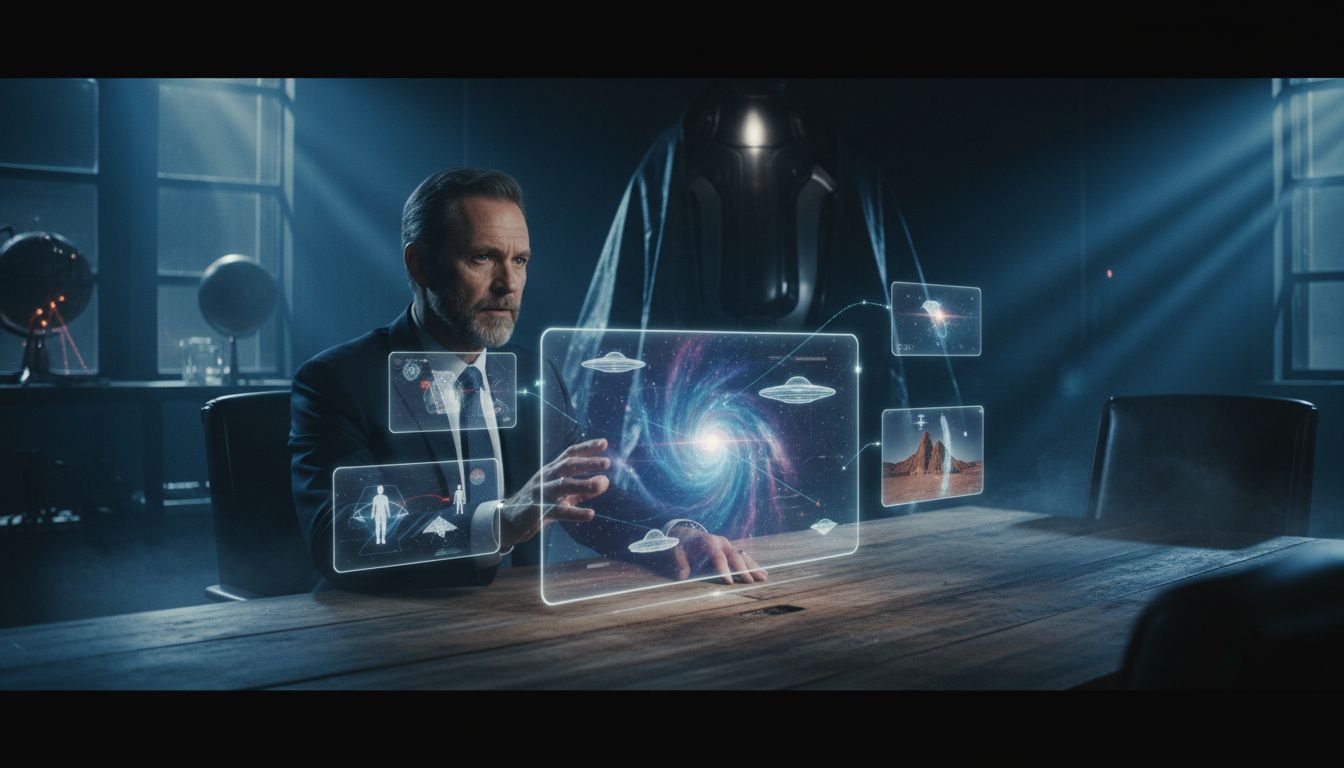
In a video interview released on April 17, 2026, astrophysicist and former Department of Defense science adviser Dr. Eric W. Davis provided an update on the United States’ ongoing investigations into unidentified aerial phenomena (UAP). Hosted by psychologist Jeffrey Mishlove, PhD, the conversation covered historical incidents, recovered craft, experimental propulsion concepts, and the role of “psionic” research. Davis, who served on the Advanced Aerospace Threat Identification Program (AATIP) and its successor AAWSAP, emphasized that classification barriers—not lack of evidence—remain the primary obstacle to public disclosure.
Historical Incident at Holloman Air Force Base
Davis recounted a 1964 event at Holloman Air Force Base in New Mexico in which three UAP reportedly approached the installation, one of which landed. According to his account, a humanoid figure wearing a breathing apparatus emerged and met with senior Air Force and CIA officials. Davis asserted that the encounter was captured on film by an Air Force helicopter crew and that a copy was later shown to then‑CIA Director George H. W. Bush. “He was told the footage existed, but he was denied access because he didn’t have a need‑to‑know,” Davis said. While the claim aligns with longstanding anecdotal reports, no declassified footage or official documentation has been released to corroborate the story.
Retrievals and Exotic Physics
Drawing on his work with legacy aerospace contractors, Davis estimated that about 40 UAP have been recovered, with roughly two‑thirds retrieved from maritime environments. He described several craft as exhibiting “topological inversion,” a condition in which interior volume exceeds exterior dimensions—a hallmark of extra‑dimensional space‑time manipulation. “If the physics we observe are correct, these objects are employing warp‑like field dynamics that go beyond conventional propulsion,” he explained. The description mirrors theoretical concepts explored in academic circles, such as Alcubierre‑type metrics, but remains unverified by peer‑reviewed research.
Psionic Research and Remote Viewing
The interview also revisited the controversial practice of employing psychics in UAP investigations. Davis referenced early‑1970s work at the Stanford Research Institute, where physicist Hal Puthoff and remote viewer Ingo Swann explored “psychic” methods for locating anomalous objects. He cited a 1976 incident at Sonoma State University in which a craft allegedly appeared after a remote‑viewing session. “There is a distinction between trained psychics—who have undergone systematic protocols—and ‘naturals’ who seem to possess innate abilities,” Davis noted. While these claims are documented in declassified CIA reports, the scientific community continues to treat them with skepticism due to a lack of reproducible evidence.
Political Disclosure and Ongoing Challenges
Davis described his involvement in classified briefings to congressional committees and the Pentagon’s UAP Task Force, noting that his data helped shape the testimony of David Grusch, the former intelligence officer who filed a high‑profile whistleblower complaint. “My research contributed to the factual matrix that Mr. Grusch presented,” Davis affirmed. He argued that the government’s “plausible deniability” policy—designed to protect national security and technological advantage—has resulted in a “highly compartmentalized” information environment, limiting even senior officials’ access to the full scope of findings.
Outlook
The interview underscores a persistent tension between scientific curiosity and political secrecy. While Davis presented a range of alleged recoveries, advanced propulsion concepts, and unconventional investigative methods, the lack of publicly available, peer‑reviewed data means that many of these claims remain unverified. Nonetheless, the continued engagement of former defense scientists, congressional oversight, and a growing public demand for transparency suggest that the discourse surrounding UAPs is moving from fringe speculation toward a more structured, albeit still constrained, inquiry.