Overview
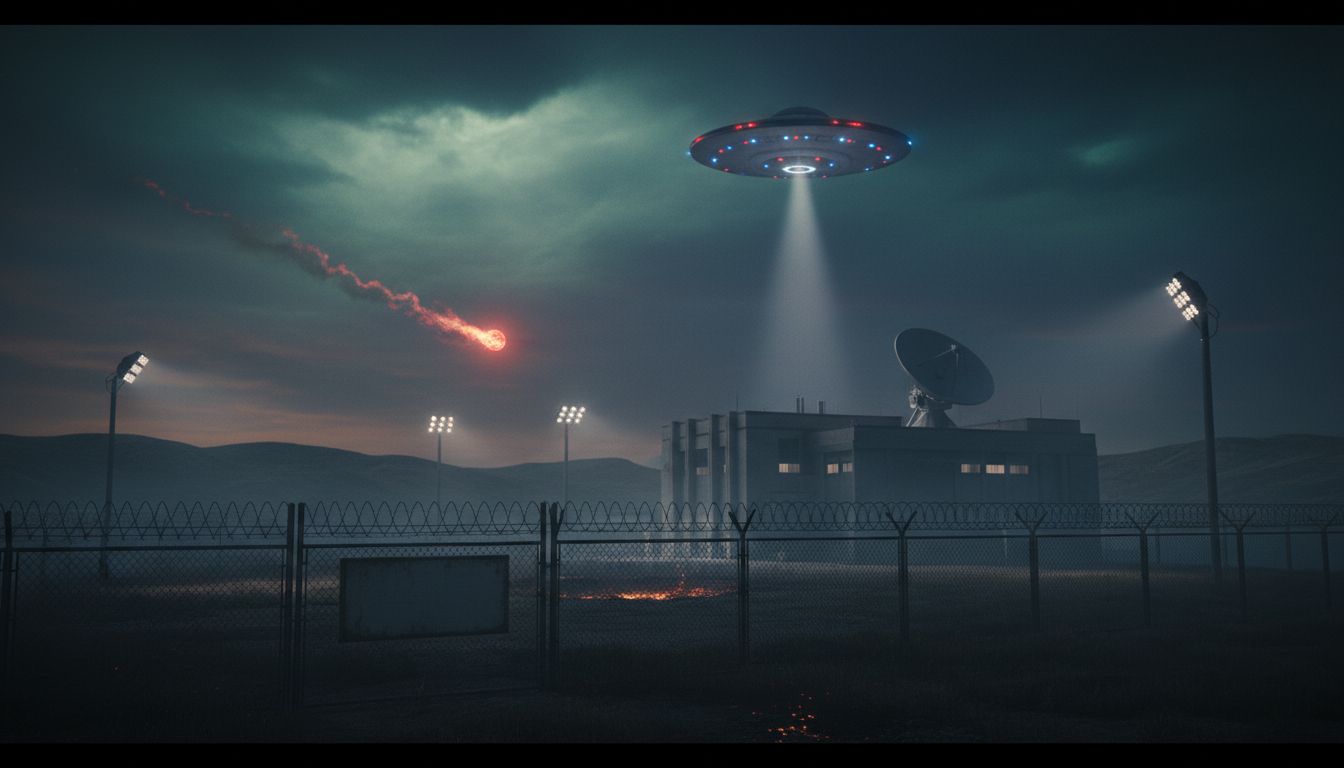
A new investigative report released this week revisits a longstanding UFO legend known among Midwest enthusiasts as the “Underdog.” The research compiles more than four decades of eyewitness accounts, archival documents, and geospatial analysis to describe a triangular craft that has repeatedly been observed over the Chicago suburbs, particularly near a location identified on historic maps as “Area 54B.” While the narrative retains a light‑hearted tone, the authors emphasize that the pattern of sightings warrants systematic documentation rather than speculation.
Craft Description and the “Firebelly” Phenomenon
According to the report, the object exhibits a distinctive lighting scheme that changes with the viewer’s perspective. When seen from above or during a descent, witnesses describe a blue‑white illuminated triangle they label “Underdog.” The underside, conversely, displays larger red and yellow lights, a configuration the authors refer to as “Firebelly.” Early investigators treated these as separate entities, but the current analysis argues they represent the same vehicle observed from different angles. A recurring technical note is the craft’s apparent electromagnetic interference with recording equipment; a cited video segment shows a camera feed blanking for roughly 60 seconds while the object hovers, a factor that has historically hampered clear photographic evidence.
Key Sightings Across Four Decades
The report highlights three benchmark events that anchor the timeline. The earliest documented case occurred on April 3, 1982, in Bolingbrook, Illinois, where amateur observer Fred Merritt filed a detailed report describing a “disc‑like craft that manifested on the ground after a brilliant streak of light.” Merritt’s dossier includes hand‑drawn schematics of the craft and its proximity to local power lines. The second, often cited as the most publicized, took place on November 7, 2006, when multiple pilots and airport staff at Chicago’s O’Hare International Airport reported a triangular formation maneuvering near the runway. The most recent claim involves a 2022 Google Street View capture near East North Frontage Road in Bolingbrook, where a faint, triangular shape appears in the background of a panoramic image.
Geographic Concentration: The Role of Area 54B
A central finding of the investigation is the spatial clustering of reports around a site labeled “Area 54B” on a 1970s topographic map of the Argonne National Laboratory vicinity. By overlaying the coordinates of each documented sighting onto a GIS model, researchers determined that all confirmed Underdog incidents fall within a 15‑mile radius of Area 54B, suggesting a localized phenomenon rather than random national occurrences. The authors caution that the label “Area 54B” is not an official government designation but a colloquial reference that has persisted in local folklore.
Recent Multiplicity and Broader Trends
The final segment of the report, titled “14 More,” documents a shift from isolated observations to multiple simultaneous craft. Footage from late 2023 shows up to fifteen triangular objects moving in coordinated patterns, a development the authors term a “dance” of Underdog units. This escalation aligns with a modest uptick in UFO reports across the United States during the same period, prompting the team to hypothesize that the phenomenon may be expanding beyond its original epicenter. Nonetheless, they stress that correlation does not equal causation, and further data collection is required to substantiate any causal link.
Conclusion
While the “Underdog” legend retains a place in regional folklore, the new report provides a methodical compilation of evidence that underscores a persistent, geographically focused series of sightings spanning more than forty years. By integrating eyewitness testimony, historical documentation, and modern geospatial tools, the investigation offers a baseline for future scholarly inquiry into unidentified aerial phenomena in the Midwest. Researchers involved in the study stress the importance of continued systematic reporting and transparent data sharing to move the conversation from anecdote to empirical analysis.


