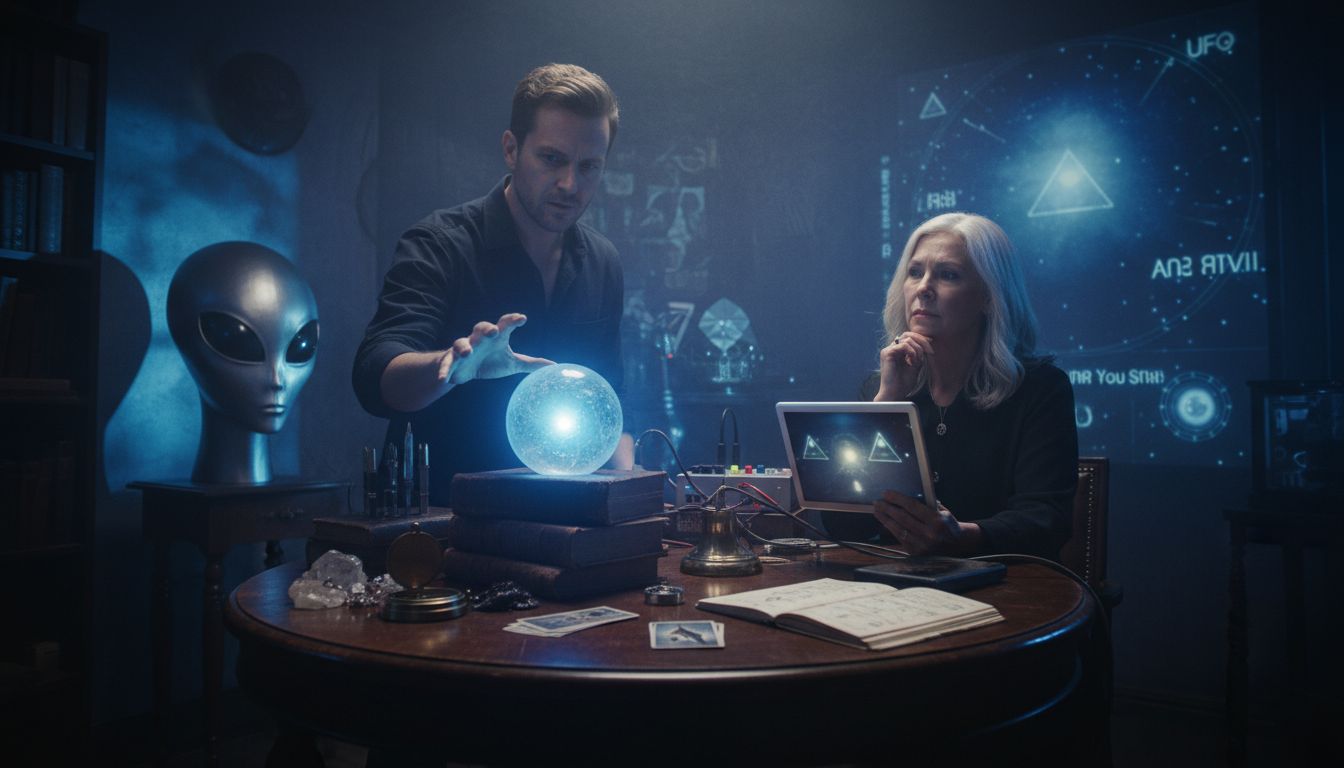
Overview
On June 10, 2025, the weekly “UAP” series on 105.7 The Point released episode 137, titled “Debriefing” with Chris Ramsey. The hour‑long conversation, hosted by the station’s UFO‑research team, featured magician‑author Chris Ramsey—a veteran of stage illusion who has spent the past decade investigating anomalous aerial phenomena (UAP) and related paranormal topics. Ramsey’s appearance marked the first time the program dedicated an entire episode to the intersection of performance magic, remote‑viewing research, and documented UFO cases, offering listeners a blend of personal experience and scholarly perspective.
Guest Background
Chris Ramsey is best known for his work as a professional magician and mentalist, but he has also authored several books on the psychology of deception and the history of occult practices. Over the last ten years, Ramsey has turned his analytical skills toward the study of unidentified aerial phenomena, collaborating with researchers at the Center for the Study of Extraterrestrial Intelligence (CSETI) and participating in controlled remote‑viewing experiments funded by the Defense Advanced Research Projects Agency (DARPA). In the podcast, Ramsey explained that his “magician’s eye” allows him to spot inconsistencies in eyewitness reports that might otherwise be dismissed as hoaxes.
“When you’re trained to create an illusion, you learn how the mind fills gaps,” Ramsey said. “That same skill helps you recognize when a witness’s story is genuinely missing data versus when it’s being consciously or unconsciously fabricated.”
Key Topics Discussed
The episode was organized around three primary themes. First, Ramsey recounted several high‑profile UFO sightings—including the 2023 Phoenix Lights resurgence and a 2024 naval encounter off the coast of San Diego—highlighting patterns of flight characteristics that defy current aeronautical engineering. Second, he delved into remote viewing, describing his participation in a series of double‑blind trials where subjects attempted to describe the interior of a sealed chamber containing a miniature replica of a known UAP model. The results, according to Ramsey, showed a statistically significant correlation between target description accuracy and participants’ prior exposure to “psi‑training” techniques used by magicians.
Finally, Ramsey explored the cultural overlap between magic performance and UAP narratives. He argued that both realms rely on a suspension of disbelief and that the language used by early 20th‑century spiritualists—terms like “energy beings” and “interdimensional travelers”—has resurfaced in modern UFO reports. This historical lens, he suggested, could help researchers differentiate between mythic embellishment and potentially verifiable phenomena.
Insights and Implications
One of the more compelling takeaways from the conversation was Ramsey’s call for methodological rigor that bridges the gap between entertainment‑based deception and scientific inquiry. He advocated for a standardized reporting protocol that incorporates psychological profiling of witnesses, a practice borrowed from forensic magic investigations. Moreover, Ramsey emphasized the need for transparent data sharing between civilian UFO groups and government agencies, noting that recent declassifications of Navy sensor footage have already sparked collaborative analyses.
“If we treat each sighting like a magic trick—identify the method, test the hypothesis, and publish the findings—we’ll move the field forward,” Ramsey concluded.
Reception and Future Directions
Listeners responded positively on the station’s social media channels, with many praising the episode for its “balanced, evidence‑based approach.” The podcast’s producers indicated that the episode will be part of a broader series aimed at integrating interdisciplinary expertise—including psychologists, aerospace engineers, and former intelligence officers—into the public discourse on UAPs.
As the UAP community continues to grapple with a surge of credible reports and increasing governmental acknowledgment, Chris Ramsey’s blend of magician’s skepticism and open‑minded inquiry offers a novel framework. Whether his suggestions for remote‑viewing protocols and witness profiling gain traction remains to be seen, but the conversation underscores a growing willingness within mainstream media to treat UFO phenomena with the same critical standards applied to other frontier sciences.


