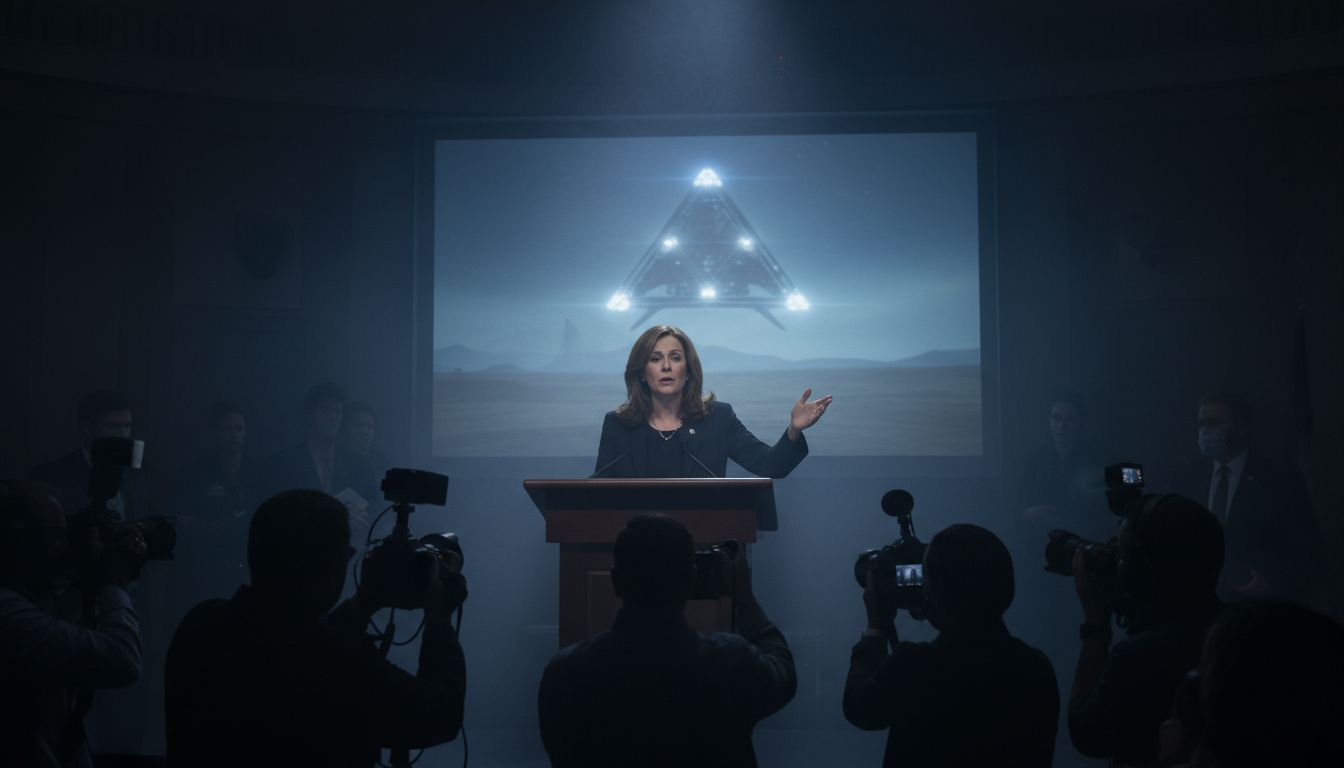
Senator Kirsten Gillibrand has renewed her call for a more robust federal investigation into unidentified aerial phenomena (UAP), arguing that the nation’s current reporting mechanisms are inadequate for a threat that could involve advanced, possibly non‑human, technology. In a statement released on October 29, the New York Democrat said the Pentagon’s existing “UAP reporting pipeline” is “buried in bureaucracy” and fails to provide timely, transparent data to both lawmakers and the public. Gillibrand’s remarks come as the Senate prepares for a series of high‑profile hearings on UAPs, scheduled for later this month, and reflect a broader push among some members of Congress for greater disclosure of what officials have termed “potentially national‑security‑relevant” encounters.
The senator’s criticism builds on the findings of the 2023 Office of the Director of National Intelligence (ODNI) report, which catalogued 144 UAP incidents between 2004 and 2021, many of which remained unexplained. While the report stopped short of confirming extraterrestrial origins, it highlighted gaps in data collection, analysis, and inter‑agency coordination. Gillibrand has cited the report’s “lack of a unified, science‑based approach” as a key reason for legislative action. “If we are seeing objects that can out‑maneuver our best fighter jets, or exhibit flight characteristics that defy known physics, we owe it to the American people to understand what we are dealing with,” she said in a press briefing on Capitol Hill.
In addition to calling for an overhaul of the reporting system, Gillibrand is urging the Senate Intelligence Committee and the Armed Services Committee to establish a permanent oversight body with the authority to compel the Department of Defense, the intelligence community, and civilian agencies to share all relevant data. She has proposed a bipartisan “UAP Accountability Act” that would formalize the role of the All‑Domain Anomaly Resolution Office (AARO), the Pentagon’s successor to the former Unidentified Aerial Phenomena Task Force, and require quarterly briefings to congressional leaders. “Transparency is not a partisan issue; it is a matter of national security and public trust,” Gillibrand told reporters, adding that the current “voluntary” reporting framework leaves many pilots and radar operators hesitant to come forward.
The senator’s push aligns with recent statements from senior defense officials who have acknowledged that the UAP issue is “real” and “requires a systematic response.” In May, Deputy Secretary of Defense Kathleen Hicks testified that the Department of Defense had “significantly increased resources” for AARO, but also noted that “the sheer volume of data and the classification of many sources” pose challenges to comprehensive analysis. Gillibrand’s advocacy therefore seeks to bridge the gap between the Pentagon’s internal efforts and the legislative branch’s oversight responsibilities. She has also urged the intelligence community to declassify historical records that could shed light on past incidents, arguing that “the longer we keep these files under lock and key, the more we erode confidence in our own institutions.”
Critics of the senator’s stance warn that an aggressive disclosure agenda could jeopardize sensitive sources and methods, potentially compromising national security. Former Pentagon officials have cautioned that some UAP sightings may involve foreign adversary technologies, and that premature public release could aid hostile actors. Nevertheless, Gillibrand maintains that a balanced approach—one that protects classified information while providing meaningful insight— is feasible. “We can protect legitimate security concerns while still giving the American people a clear picture of what’s happening in our skies,” she said, concluding that a “transparent, accountable process is essential for both security and democratic accountability.”