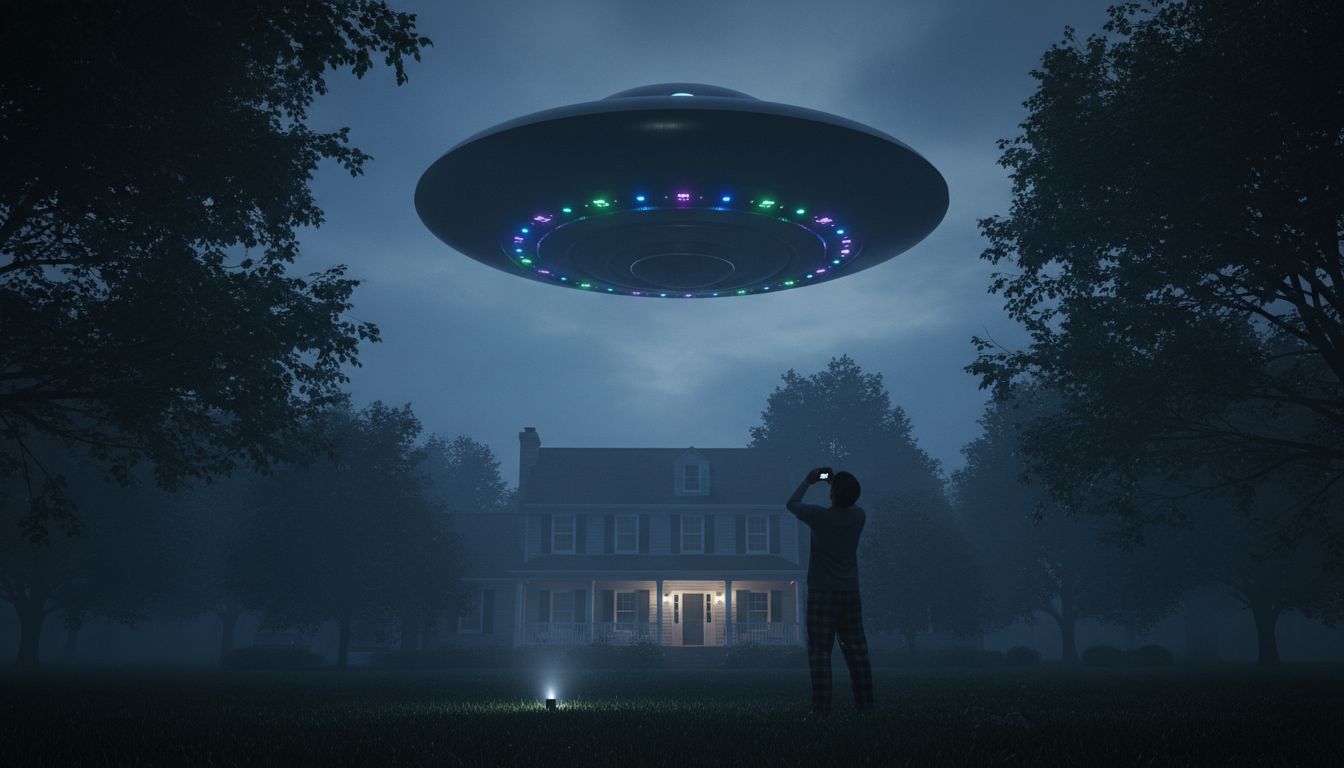
A resident of a suburban community in Virginia reported an unusual aerial encounter on the night of October 25, 2025, describing a silent, disc‑shaped object that hovered directly above his home for several minutes before accelerating away at a rapid pace. According to the witness, the phenomenon emitted no audible noise and was marked by a series of steady, pulsating lights that changed color from a soft white to a faint amber hue. The observer, who asked to remain anonymous for personal safety reasons, said the object remained motionless for about three minutes, giving him enough time to record the event on his smartphone before it vanished in a sudden, upward thrust.
The account was first posted on the open‑source UFO‑focused outlet OpenMinds.tv, which has catalogued similar residential sightings across the United States in recent months. The report aligns with a broader pattern of anomalous aerial phenomena (AAP) documented by civilian observers, particularly in the eastern seaboard states, where a spike in sightings was noted in the 2024‑2025 reporting period. The National UFO Reporting Center (NUFORC) logged 1,274 reports from Virginia alone in 2024, a 22 percent increase over the previous year, with many descriptions mentioning “disc‑shaped” or “cigar‑shaped” objects that exhibit silent hover capabilities.
Federal interest in such reports has intensified since the Department of Defense’s Unidentified Aerial Phenomena (UAP) Task Force released its 2023 preliminary assessment, which acknowledged that a subset of sightings could involve advanced technology not currently understood by the United States. While the Pentagon’s report emphasized the need for more rigorous data collection, it also noted that many civilian accounts—particularly those with video or photographic evidence—could help fill gaps in the existing data set. In this case, the Virginia witness’s smartphone footage, which has not yet been released publicly, may provide valuable visual corroboration if submitted to the All‑Domain Anomaly Resolution Office (AARO), the agency now tasked with consolidating UAP data across military and civilian sources.
Experts caution against drawing definitive conclusions from a single anecdotal report. Dr. Michael S. Hoffman, a senior researcher at the UAP research nonprofit UAPx, remarked that “the characteristics described—a silent, hovering disc with changing illumination—are consistent with several documented cases, but without corroborating radar data or multiple independent witnesses, the event remains an unverified observation.” He added that atmospheric phenomena, drones, or classified test flights can sometimes produce similar visual effects, especially under low‑light conditions.
Nevertheless, the incident adds to an accumulating body of civilian testimony that underscores the need for systematic, transparent investigation. In response to growing public concern, several members of Congress have introduced legislation aimed at improving data sharing between defense agencies and civilian reporting platforms. If the Virginia witness’s video is authenticated and cross‑referenced with any nearby radar or satellite logs, it could contribute to a more comprehensive understanding of the capabilities and origins of such objects. Until then, the silent disc over a Virginia backyard remains a compelling, yet unverified, piece of the broader UAP puzzle that continues to capture both public imagination and scientific scrutiny.


