Overview
In the months after the Fox sisters’ famous “rappings” at Hydesville, New York, a new question emerged among the curious and the grieving: would the unseen voice speak again, and for whom? By late 1848, informal gatherings in private homes began to shift from investigations of a possible hoax to earnest attempts to hear loved ones who had passed away. These early spiritualist séances, organized around the Fox sisters’ claims, offered a quiet, ritualized setting where participants waited for knocks, taps, or faint sounds that were interpreted as messages from the dead.
The Early Séances
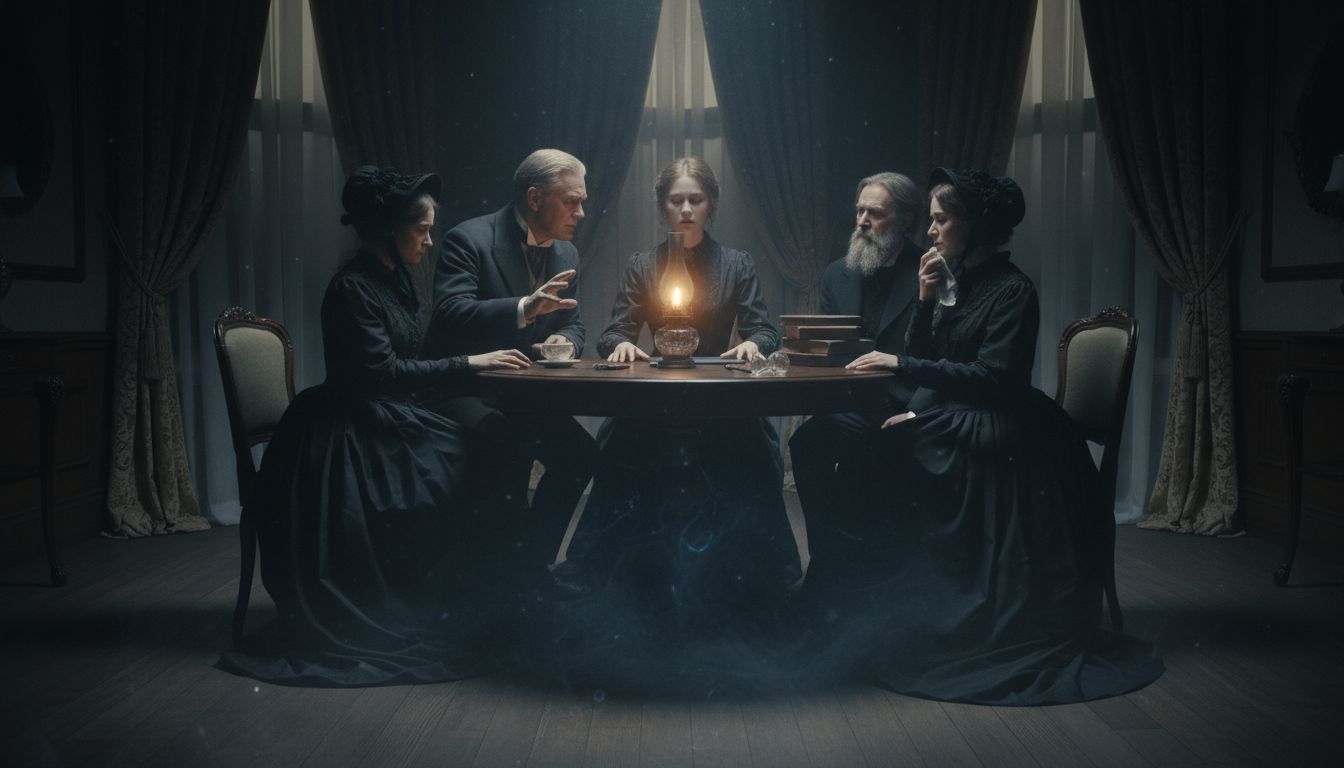
The rooms where these meetings took place were deliberately arranged. Chairs were set in a circle, a small table placed at the center, and the participants—often strangers bound only by a shared loss—sat in solemn silence. Contemporary accounts describe the atmosphere as “unbearably quiet,” with attendees whispering, “Are you there?” before the long pause that followed. Unlike the noisy public exhibitions that would later characterize some spiritualist shows, these gatherings relied on subtle auditory phenomena—soft raps on wood, faint scratches on glass—that participants believed were the voices of departed relatives. The Fox sisters themselves began to hold “sittings” beyond Hydesville, guiding the ritual and interpreting the sounds for the assembled mourners.
Charles Livermore’s Sessions
One of the most documented cases involved Boston banker Charles Livermore, who attended a series of séances after the death of his wife, Margaret, in 1849. Livermore’s involvement was not a fleeting curiosity; he returned night after night, seeking reassurance. According to the séance log kept by the medium, a series of distinct knocks—three short taps, a pause, then two longer ones—were recorded on the night of March 12, 1850. The medium relayed the pattern to Livermore, who identified it as the “M‑R‑M” code his wife had used in private letters. In a subsequent session, the “voice” allegedly disclosed the location of a hidden family heirloom Margaret had mentioned only once, confirming the specificity of the communication.
Livermore also reported that the spirit referenced historical figures, naming Abraham Lincoln and the poet Henry Wadsworth Longfellow, and reciting lines from Longfellow’s “The Song of Hiawatha.” While skeptics argued that the medium could have accessed publicly known information, Livermore’s insistence that the details were “intimate and previously unknown to any living person” added a layer of intrigue that attracted newspaper coverage across New England.
Public Transformation of Private Grief
These early cases marked a turning point: grief, previously a private affair, became a public spectacle of communication with the beyond. Newspapers such as The New York Herald and The Boston Daily Advertiser began publishing summaries of séance sessions, often quoting participants’ emotional reactions. The phenomenon also spurred the formation of spiritualist societies, the first of which, the Spiritualist Association of New York, was founded in early 1850. Membership rosters show a diverse cross‑section of society—bankers, clergy, and housewives—all united by the desire to hear a voice from the dead. This democratization of the supernatural helped cement spiritualism as a cultural movement rather than a fringe curiosity.
Scholarly Perspective
Historians of religion note that the post‑Hydesville period illustrates how cultural context can reshape paranormal experiences. Dr. Eleanor Whitaker of the University of Chicago’s Department of History of Religion remarks, “The shift from investigative skepticism to earnest listening reflects a broader 19th‑century preoccupation with mortality and the afterlife, amplified by rapid social change.” Contemporary researchers caution against sensationalism, emphasizing the need for rigorous documentation of séance protocols and participant testimony. Nevertheless, the Livermore case and similar early reports remain valuable primary sources for understanding how spiritualist practices evolved from isolated incidents into organized, socially influential movements.
Continuing Legacy
While later exposés would reveal fraudulent practices among some mediums, the early séances following the Fox sisters’ Hydesville raps left an indelible mark on American cultural history. They demonstrated that personal loss could be channeled into collective rituals, offering comfort to those who felt isolated in their mourning. Today, modern spiritualist congregations trace their origins to these mid‑19th‑century gatherings, and the archival records of sessions like Charles Livermore’s continue to inform both scholarly inquiry and public fascination with the possibility of hearing a voice from beyond.