Overview
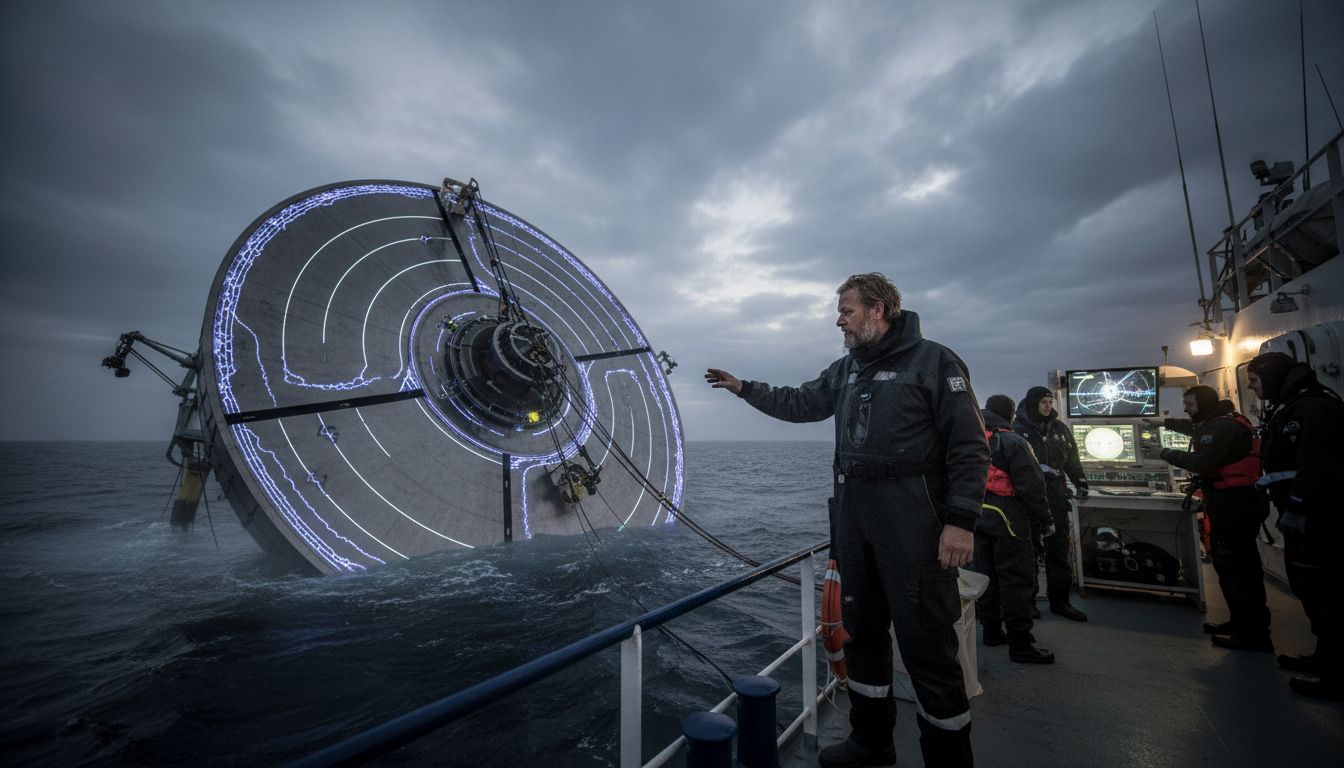
Swedish treasure hunter Dennis Åsberg has renewed interest in the long‑standing mystery known as the Baltic Sea Anomaly, a roughly 60‑meter‑diameter disc‑shaped formation resting about 90 metres beneath the surface of the Baltic Sea. In a recent interview with VibeWire Magazine, Åsberg described the site as exhibiting “unusual geometry and electromagnetic effects,” and claimed that his team has recovered material samples that do not correspond to any known natural or man‑made objects. While the anomaly has attracted speculative headlines—including Åsberg’s own quip, “We found a UFO at the bottom of the Baltic Sea!”—the investigation remains scientifically inconclusive after more than a decade of exploration.
Key Observations
During a series of dives conducted over the past twelve months, Åsberg’s crew recorded several phenomena that set the anomaly apart from typical seafloor features. Sonar imaging revealed a smooth, circular outline with pronounced right‑angled edges, a geometry that is rare in natural rock formations. On‑site magnetometers detected localized electromagnetic disturbances that caused the ROV’s instruments to fluctuate when positioned within a ten‑metre radius of the structure. Additionally, temperature probes registered sharp drops of up to 7 °C compared with surrounding water, an effect Åsberg attributes to an unknown heat‑sink or conductive material embedded in the object. The team collected fragments of a black, glass‑like substance that, when examined under a portable microscope, displayed a micro‑crystalline pattern unlike typical basalt or marine sediment. Åsberg declined to release the samples for independent analysis, citing concerns about preservation and potential contamination.
Scientific Context
The Baltic Sea Anomaly first entered public awareness in 2011 when a group of Swedish divers captured low‑resolution sonar footage that suggested an artificial‑looking structure. Since then, marine geologists have offered competing explanations, ranging from a glacial erratic—a large rock deposited by ancient ice sheets—to a pumice mound formed by underwater volcanic activity. However, the presence of right angles and electromagnetic anomalies challenges conventional geological models, prompting some researchers to propose a human‑made origin, such as a sunken Cold‑War‑era experimental platform. Dr. Karin Lindström of the Swedish University of Marine Sciences cautioned, “While the shape is intriguing, without peer‑reviewed laboratory data on the recovered material, we cannot rule out natural processes that mimic engineered forms.”
Ongoing Investigation
Åsberg’s organization, Baltic Depth Explorers, has applied for a research permit to conduct a multi‑disciplinary survey involving marine archaeologists, physicists, and materials scientists. The proposed mission aims to deploy high‑resolution multibeam sonar, sub‑bottom profiling, and in‑situ spectroscopy to map the object’s internal structure. Funding, however, remains a hurdle; the venture is currently supported by private investors and a modest crowdfunding campaign that has raised ≈ $150,000. Åsberg emphasized transparency, stating, “We intend to publish all data in an open‑access repository once the analysis is complete, because extraordinary claims require extraordinary evidence.” The scientific community has responded with cautious interest, noting that the Baltic Sea’s brackish water and low sedimentation rates could preserve anomalous artifacts better than many other marine environments.
Outlook
Fifteen years after the anomaly’s initial discovery, the Baltic Sea continues to host one of the most persistent underwater enigmas in modern ufology and marine archaeology. While Åsberg’s recent findings add compelling new data points—particularly the temperature anomalies and electromagnetic signatures—the lack of peer‑reviewed analysis keeps the object firmly in the realm of speculation. As the planned expedition moves forward, the broader research community will be watching closely to see whether the “UFO” label is a sensational shorthand for an unexplained marine phenomenon or a breakthrough that reshapes our understanding of human activity in the Baltic’s depths. Until then, the disc‑shaped silhouette remains a silent, submerged question mark on the seafloor, awaiting rigorous scientific scrutiny.