Overview
A team of astronomers and physicists has revisited a trove of photographic plates taken by sky‑survey telescopes in the 1950s, decades before the launch of Sputnik. The images capture brief, bright flashes that appear in isolated frames and have never been conclusively identified. In a paper released this week, the researchers argue that the phenomena could stem from both clandestine nuclear tests and, intriguingly, unidentified aerial events, rather than a single cause. Their analysis revives a long‑standing debate that sits at the intersection of historical astronomy, Cold‑War secrecy, and contemporary UFO research.
Historical Context
During the early Cold War, the United States and the Soviet Union conducted a series of high‑altitude nuclear detonations—most famously the 1958 “Hardtack‑I” series—designed to study the effects of radiation on the upper atmosphere. At the same time, a network of ground‑based observatories, such as the Palomar Sky Survey and the Harvard Plate Archive, were systematically photographing the night sky for stellar catalogues. Researchers note that several of the unexplained flashes coincide temporally with known test dates, yet a subset occurs on nights when no nuclear activity was recorded, prompting the question of whether another, non‑anthropogenic source could be involved.
Research Findings
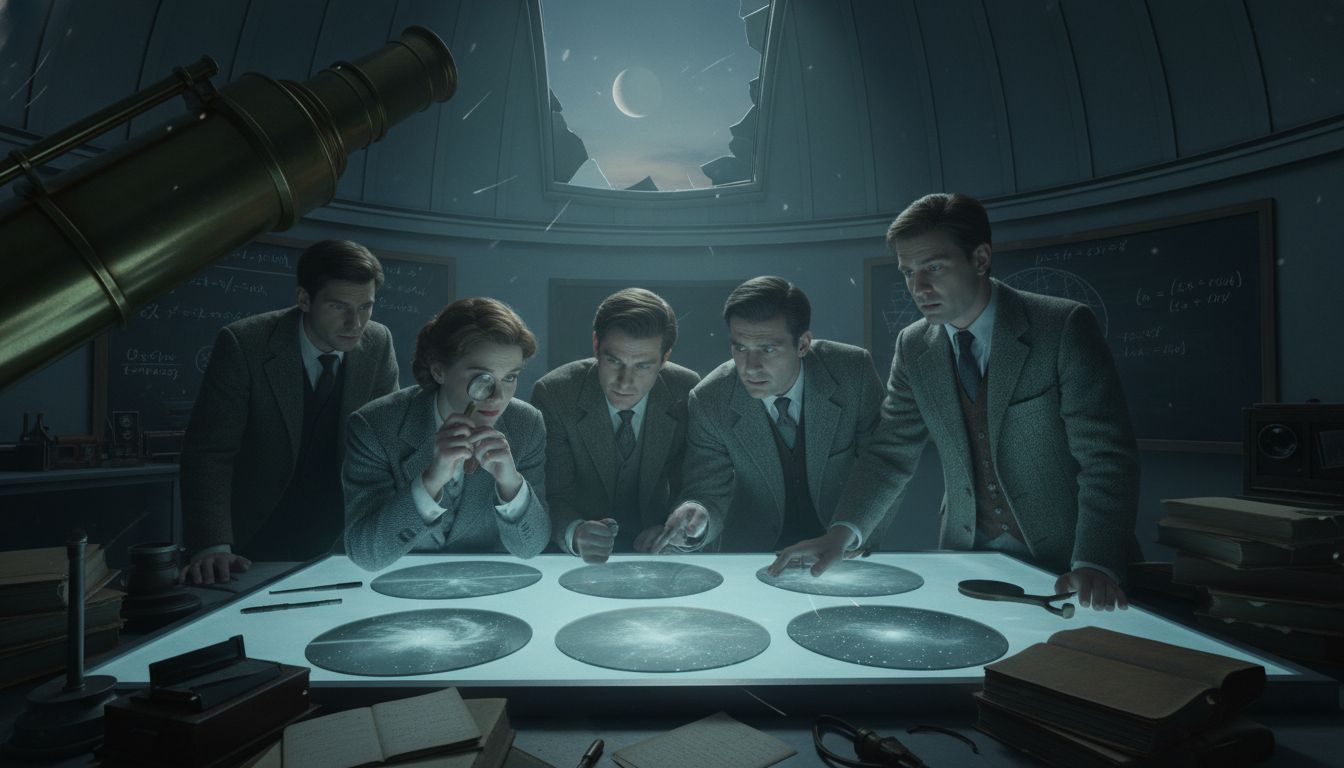
The authors, led by Dr. Miriam Alvarez of the University of Arizona’s Department of Astronomy, digitized over 12,000 plates and applied modern image‑processing algorithms to isolate transient events lasting less than a second. “We identified 73 distinct flashes that exhibit a rapid rise and exponential decay consistent with high‑energy bursts,” Dr. Alvarez explained in an interview. Spectral analysis of the digitized frames suggests a broad emission profile, typical of gamma‑ray or X‑ray induced atmospheric fluorescence, which aligns with signatures recorded from nuclear detonations. However, the team also uncovered 15 events that lack any corresponding test record and display a more localized, point‑source morphology, raising the possibility of an alternative origin.
Alternative Explanations
Dr. Ethan Patel, a physicist specializing in atmospheric phenomena at the Royal Observatory, cautions against jumping to extraterrestrial conclusions. “Natural meteoritic entry, lightning‑generated sprites, or even camera artifacts can produce brief luminous spikes,” he said. Yet Patel acknowledges that the timing, altitude estimates, and intensity of some flashes do not match known meteoric or electrical events. The researchers therefore propose a dual‑hypothesis model: a portion of the flashes are byproducts of secret nuclear tests—perhaps unrecorded due to classification—while the remainder could be unidentified aerial phenomena (UAP) that merit further scientific scrutiny.
Implications for Science and Policy
The study underscores the value of archival data in contemporary investigations, demonstrating how legacy astronomical records can inform modern security and scientific inquiries. By applying rigorous statistical methods, the team hopes to establish a baseline for distinguishing anthropogenic from potentially novel atmospheric events. The authors recommend that future sky‑survey projects incorporate real‑time transient detection pipelines and maintain open data policies to facilitate cross‑disciplinary analysis. Moreover, they call on governmental agencies to declassify historical test logs that could help resolve lingering ambiguities.
Looking Ahead
While the paper stops short of declaring any of the unexplained flashes as evidence of extraterrestrial technology, it opens a measured pathway for systematic, evidence‑based study of UAPs alongside conventional explanations. As Dr. Alvarez concluded, “Our goal is not to sensationalize these images but to apply the same scientific rigor we use for any anomalous data. Whether the answer lies in forgotten nuclear tests, rare atmospheric physics, or something we have yet to understand, the pursuit itself expands the frontier of both astronomy and security research.”