Overview
Amid the renewed wave of UAP disclosures, New Dawn Magazine revisited a long‑standing classification scheme first articulated by ufologist John White. In a 2017 interview, White—who holds degrees from Dartmouth and Yale and has authored fifteen books on consciousness and paranormal research—argued that the UFO phenomenon cannot be reduced to a single explanation. Drawing on the Mutual UFO Network’s (MUFON) definition of “unidentified flying objects” as “objects observed in the skies or on the surface of the Earth which defy conventional explanation after a thorough study,” he proposes a three‑tiered framework that separates sightings into terrestrial, extraterrestrial, and metaterrestrial categories.
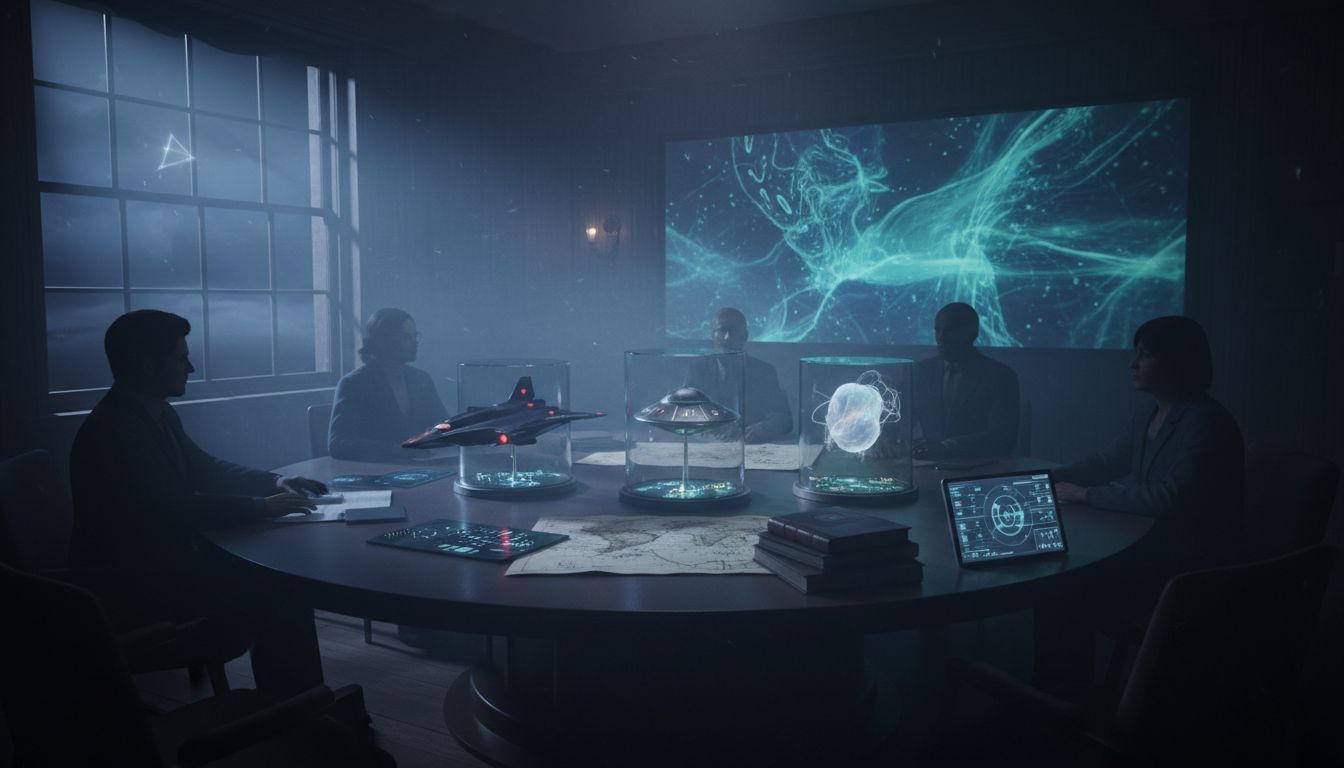
The Three‑Level Framework
White’s model treats each level as a distinct “aspect of reality,” each with its own characteristic manifestations. He cites MUFON’s catalog of sightings—ranging from misidentified balloons and satellites to “daylight discs” tracked visually and on radar at extraordinary speeds—to illustrate the breadth of the data set. “Little green men in spaceships with Martian license plates may be part of the puzzle, but that is only one piece of it,” White told New Dawn, emphasizing that all three categories are genuine and real, though they differ qualitatively. The terminology for the third tier, “metaterrestrial,” was originally coined by Dr. J. Allen Hynek to denote phenomena that lie beyond ordinary three‑dimensional space.
Terrestrial Phenomena
The terrestrial tier encompasses sightings that can ultimately be traced to human technology or natural atmospheric events. White points to the large proportion of cases that resolve as “identified flying objects” (IFOs) once investigators rule out misperception. Examples include high‑altitude balloons, commercial satellites, meteors, and even experimental aircraft. In many instances, radar signatures and visual observations align with known objects, allowing researchers to close the case without invoking exotic explanations. This level, while less sensational, remains crucial for establishing methodological rigor and filtering out false positives from the larger dataset.
Extraterrestrial Possibilities
At the extraterrestrial level, White references sightings that involve physical evidence, such as trace marks, anomalous materials, or authenticated photographs that resist conventional analysis. He also notes reports of “close encounters” where witnesses describe humanoid entities or direct contact. While the scientific community remains divided over the veracity of such claims, White argues that the consistency of certain patterns—high‑speed maneuvering, abrupt acceleration, and radar‑visual correlation—suggests a technological origin beyond current Earth‑based capabilities. He cautions, however, that definitive proof of an off‑world source remains elusive, underscoring the need for continued systematic data collection.
Metaterrestrial Dimension
The metaterrestrial category, the most speculative of the three, addresses phenomena that appear to operate outside the familiar three‑dimensional framework. Drawing on Hynek’s original usage, White describes encounters that involve interdimensional or trans‑dimensional characteristics—objects that seemingly appear and disappear, defy the laws of physics, or produce effects that cannot be measured by conventional instruments. Such reports often include “psychic” or consciousness‑related components, linking the UFO field to broader questions in parapsychology and consciousness research. White’s interdisciplinary background informs his view that these cases may reflect a metaphysical dimension of reality, demanding a research approach that bridges hard science and experiential inquiry.
Implications for Future Research
White’s tripartite model encourages investigators to stratify data rather than forcing disparate cases into a single narrative. By recognizing the distinct signatures of terrestrial, extraterrestrial, and metaterrestrial sightings, researchers can apply tailored methodologies—ranging from aerospace forensics to quantum‑level measurement and phenomenological analysis. As governments worldwide declassify more UAP files, the framework offers a pragmatic lens for sorting credible evidence from noise. “The UFO phenomenon is multilevelled and can’t be explained in a unified fashion,” White concluded, reminding both skeptics and believers that objective, tiered inquiry may be the most productive path forward.