Overview
Ars Technica recently sat down with particle physicist Daniel Whiteson, co‑author of the newly released book Do Aliens Speak Physics? And Other Questions About Science and the Nature of Reality. Illustrated by cartoonist Andy Warner, the volume uses speculative scenarios to probe how humanity might—or might not—communicate with an extraterrestrial intelligence. The conversation, conducted shortly after the book’s launch, highlights Whiteson’s long‑standing interest in the philosophical limits of physics and his concern that the “universal” nature of scientific laws may be more human‑centric than commonly assumed.
Physics Beyond the Human Lens
Whiteson, a researcher on the ATLAS experiment at CERN, explains that his curiosity stems from a “implicit promise” that physics reveals truths that hold everywhere. He cautions, however, that this promise may be oversold. “None are fundamental, and we don’t understand why anything emerges,” he told Ars Technica. The book therefore asks whether the mathematical frameworks we rely on—geometry, calculus, quantum theory—would be recognizable to a species whose sensory apparatus and evolutionary pressures differ radically from ours. By framing each chapter around a concrete, fictional first‑contact vignette, the authors illustrate how even basic concepts such as “force” or “mass” could be alien to an intelligence that perceives the universe through a completely different set of constants.
Linguistic and Cultural Barriers
Beyond the abstract question of shared mathematics, the authors delve into linguistic and cultural obstacles. An alien language would likely be shaped by its environment—gravity, atmospheric composition, or the presence of a magnetic field could dictate the range of perceivable frequencies. Moreover, cultural constructs such as time, individuality, or even the notion of “science” may be absent. Whiteson notes, “Their language will be shaped by their home environment, broader culture, and even how they perceive the universe.” The book explores scenarios where attempts at symbolic exchange break down because the underlying semantic frames are incompatible, echoing real‑world challenges faced by human linguists when deciphering undocumented languages.
SETI, Consciousness, and Alternative Physics
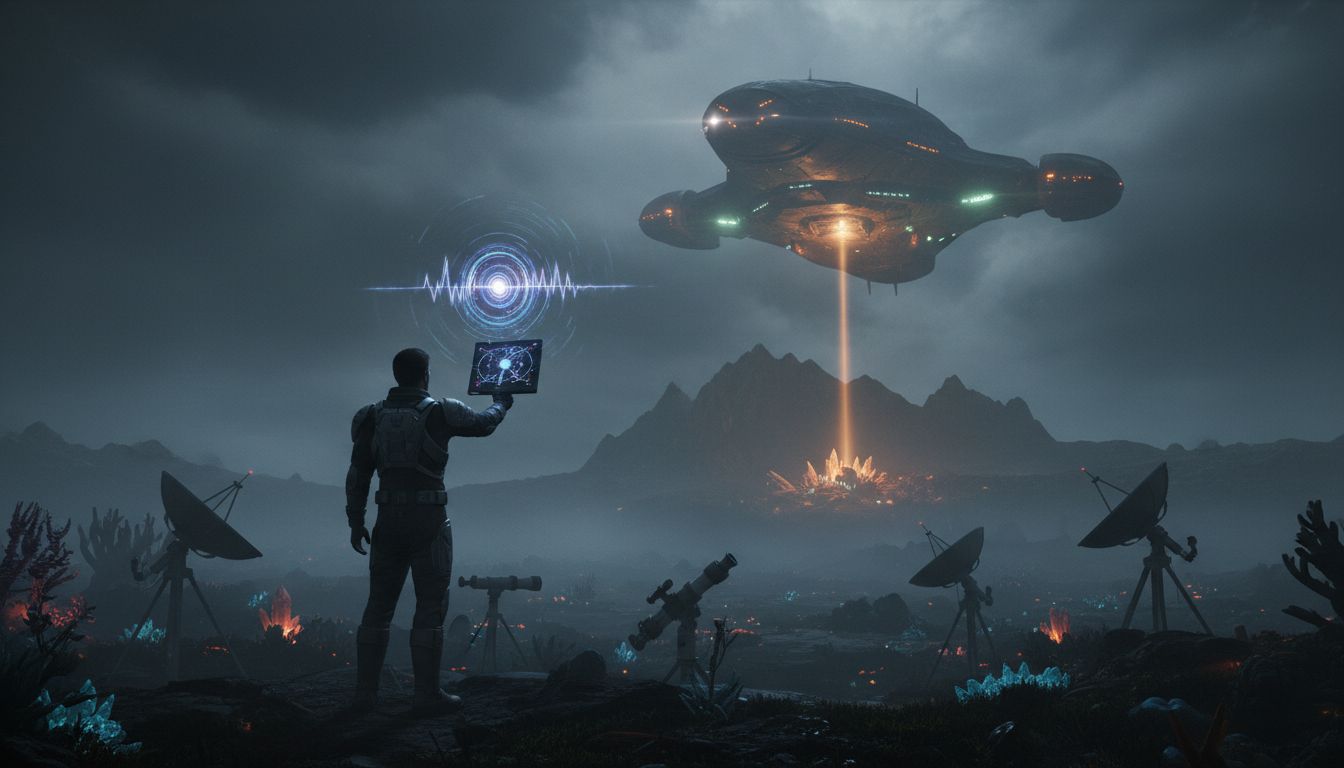
The work also touches on ongoing SETI strategies, which typically assume that an advanced civilization would transmit signals rooted in universal mathematics (e.g., prime number sequences). Whiteson argues that this assumption may be naïve if alien cognition operates on principles outside current physical theory—such as emergent consciousness that directly manipulates spacetime, a notion occasionally floated in fringe discussions of quantum mind‑matter interactions. While the book does not endorse speculative physics, it treats these ideas as boundary conditions for thinking about communication: if an extraterrestrial species harnesses “alternative physics,” our detection methods might miss them entirely. The authors thus call for a broader, interdisciplinary approach that includes philosophy, biology, and even art to anticipate non‑standard modes of contact.
Reception and Future Outlook
Do Aliens Speak Physics? has been praised for its blend of rigorous scientific insight and accessible storytelling. The collaboration between Whiteson and Warner, who “cold‑emailed” each other to combine expertise with whimsical illustration, results in a volume that is both educational and entertaining. Early reviewers highlight the book’s ability to make abstract concerns—like the potential distortion of observation by a “human lens”—tangible through imagined dialogues with alien scientists. As humanity continues to scan the cosmos for technosignatures, the authors suggest that preparing for communication failures may be as crucial as the search itself. Their final message: the path to first contact will likely require humility, interdisciplinary dialogue, and a willingness to rethink what we consider “universal” in science.