Overview
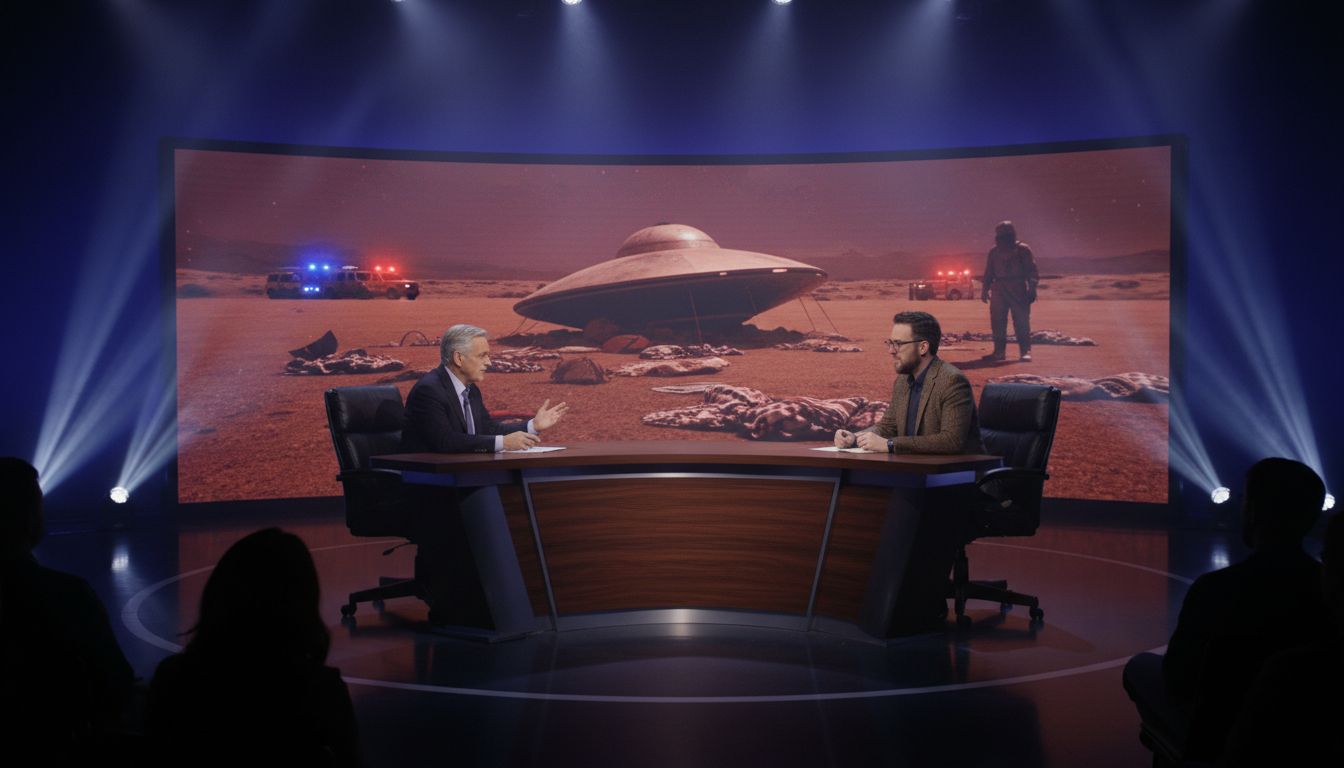
In the latest episode of Gaia’s Beyond Belief hosted by veteran broadcaster George Noory, author and UFO researcher Nick Redfern presented a provocative reinterpretation of the 1947 Roswell incident. Rather than an extraterrestrial crash, Redfern argues the event was a human‑engineered experiment concealed behind the myth of alien visitation. The discussion, recorded on December 3, 2025 and highlighted in VibeWire Magazine, delves into declassified Cold War programs, psychological‑operations (psy‑ops) tactics, and a coordinated media strategy designed to shape public perception of a nascent “space age” threat.
New Claims and Evidence
Redfern’s thesis rests on three interlocking strands of evidence. First, he cites recently released Air Force documents that detail Project Mogul, a high‑altitude balloon program intended to detect Soviet nuclear tests. According to Redfern, the debris recovered at the Roswell crash site—metallic foil, rubber, and instrumentation—matches the materials described in those files, not the “flying saucer” narrative popularized in the 1950s. Second, he points to psychological‑warfare manuals from the Office of Naval Intelligence that outline deliberate misinformation campaigns aimed at diverting attention from secret weapons development. “The Roswell story was a perfect cover,” Redfern told Noory, “a sensational distraction that kept the public looking up while we were building the next generation of surveillance technology.” Finally, Redfern references testimony from former intelligence officers who recall controlled leaks of UFO sightings in the late 1940s, intended to sow confusion and test the nation’s response to unconventional threats.
Historical Context
The Roswell crash has long been a flashpoint in UFO lore, spawning countless books, documentaries, and conspiracy theories. In the immediate aftermath, the Army Air Forces issued a press release claiming the recovery of a “flying disc,” only to retract the statement hours later, attributing the wreckage to a weather balloon. Over the ensuing decades, the narrative shifted, with civilian groups such as the National Investigations Committee on Aerial Phenomena (NICAP) amplifying claims of alien bodies and government cover‑ups. Redfern’s analysis situates Roswell within the broader Cold War environment, when the United States aggressively pursued technological superiority and experimented with covert influence operations. By framing the incident as a psychological test, the episode suggests that the alien mythos may have been an unintended byproduct of strategic deception rather than a spontaneous public fascination.
Expert Commentary
Redfern’s arguments have drawn both support and skepticism from the UFO research community. Dr. Jillian B. Harper, a historian of Cold War intelligence at the University of Texas, notes, “There is undeniable documentation of Project Mogul and related psy‑ops, but linking those directly to the Roswell narrative requires a leap that still lacks corroborating eyewitness testimony.” Conversely, former Air Force pilot Lt. Col. (Ret.) Mark Daniels, who served in the 1940s, told Noory, “I was in the vicinity of Roswell when the debris was recovered. The description matches a high‑altitude balloon, not any known aircraft of the era.” These perspectives underscore the difficulty of separating classified program details from the layers of myth that have accumulated over nearly eight decades.
Implications for UFO Disclosure
If Redfern’s assessment holds merit, the Roswell incident could represent the earliest known example of government‑sponsored misinformation about unidentified aerial phenomena. This reframing would have ripple effects for contemporary debates on UFO transparency, suggesting that some “extraterrestrial” sightings may be rooted in deliberate obfuscation rather than genuine alien encounters. The episode also raises questions about the ethical boundaries of psychological warfare, especially when civilian belief systems are manipulated for strategic gain. As the U.S. Department of Defense continues to release unclassified reports on UAPs, scholars and policymakers may need to revisit historical cases like Roswell with a more nuanced lens that accounts for both technological secrecy and information control.
The Beyond Belief conversation, as reported by VibeWire Magazine, invites a reassessment of America’s most iconic UFO mystery. While definitive proof remains elusive, Redfern’s synthesis of Cold War documentation and psy‑ops doctrine provides a compelling, if controversial, alternative to the extraterrestrial hypothesis—one that underscores the enduring interplay between national security imperatives and public imagination.