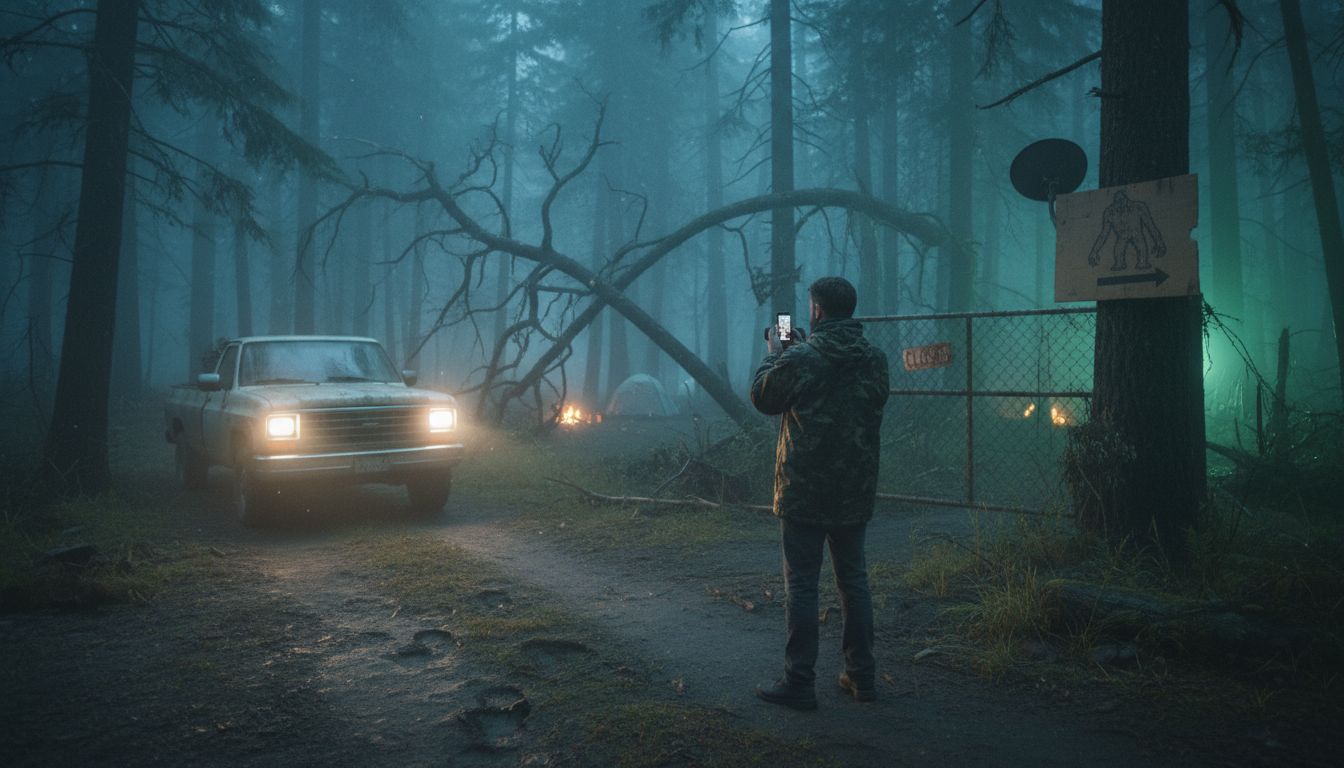
The recent report of a creature crossing Interstate 80 near State College, Pennsylvania, has sparked a familiar debate among cryptid enthusiasts: where should a witness turn when confronted with an unexplained sighting? On October 4, at roughly 5:30 p.m., a driver described a “tall, all‑dark figure” that sprinted across the highway, leapt over a guardrail and vanished into the median. The witness, identified only as B.G., recorded the encounter with the Bigfoot Field Researchers Organization (BFRO), the informal network that has become the primary repository for such claims. The BFRO entry notes the figure moved “quickly and smoothly,” covering the width of the road in three to four strides in about three seconds—an observation that, according to B.G., defied the proportions of any known animal or human.
The incident illustrates a broader structural gap in the way anomalous wildlife or “cryptid” sightings are handled. Unlike reports of endangered species or roadkill, there is no federal or state agency tasked with investigating alleged Sasquatch encounters. Consequently, witnesses often default to media outlets or hobbyist groups. In this case, the driver’s story first appeared in a local Penn Live article before being logged on the BFRO website, where the report is publicly accessible. “I tried to follow the car ahead to talk to the other driver, but I couldn’t catch up,” B.G. recalled, underscoring how the lack of an official reporting channel can leave potentially valuable eyewitness accounts fragmented and difficult to corroborate.
Scientists and law‑enforcement officials typically treat such reports with caution, emphasizing the need for verifiable evidence before allocating resources. Dr. Emily Hart, a wildlife biologist at Pennsylvania State University, notes that “highways are frequented by a range of nocturnal mammals, and visual perception can be compromised by speed, lighting and expectation.” She adds that without physical traces—such as footprints, hair samples, or clear video—most sightings remain anecdotal. The BFRO, while meticulous in cataloguing details, does not possess the forensic capabilities of a research institution, and its findings are not peer‑reviewed. Nonetheless, the organization provides a structured format for documenting time, location, environmental conditions and witness impressions, which can be useful for pattern analysis over time.
The cultural resonance of Bigfoot, or Sasquatch, continues to shape how such encounters are interpreted. The creature occupies a liminal space between folklore and modern myth, appearing in everything from television documentaries to internet memes. This persistence fuels a community of amateur investigators who share sightings on forums, social media groups and podcasts, often framing their experiences as evidence of a hidden, intelligent species. As journalist Sharon A. Hill observes, “the fascination with Sasquatch in modern folklore persists because it taps into a collective yearning for mystery in an increasingly data‑driven world.” That yearning can, however, blur the line between curiosity and sensationalism, prompting some observers to jump to paranormal conclusions without first exhausting mundane explanations.
While the Pennsylvania sighting adds another entry to the BFRO’s growing database, it also highlights the need for a more systematic approach to anomalous wildlife reports. Some scholars suggest establishing a liaison office within state wildlife agencies to receive and triage such claims, ensuring that credible leads receive scientific attention while filtering out misidentifications. Until such mechanisms are in place, witnesses like B.G. will likely continue to rely on informal networks and local media, perpetuating a cycle in which cryptid sightings remain on the periphery of mainstream scientific inquiry.