Overview
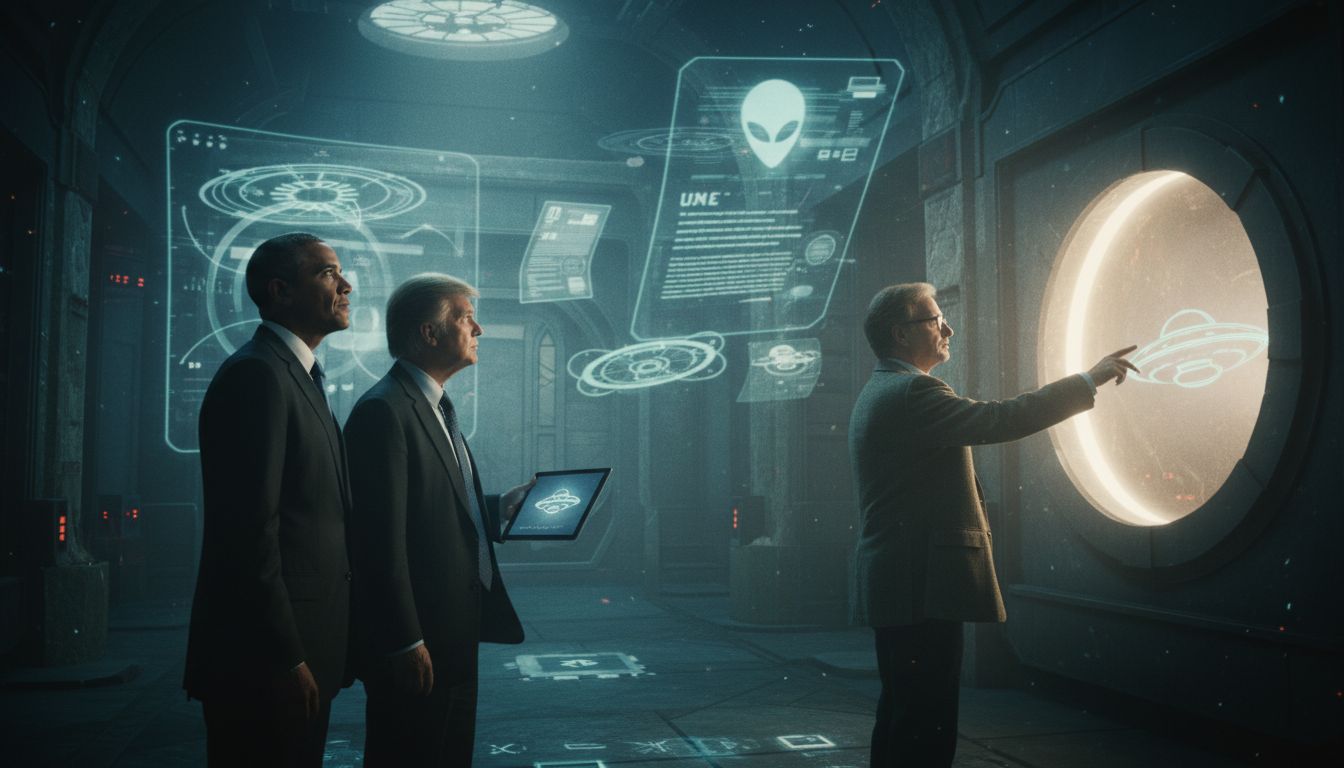
A wave of public statements from high‑profile figures is bringing the question of extraterrestrial life back into mainstream conversation. Former President Barack Obama hinted in a recent podcast that “aliens are real,” while his successor, Donald Trump, pledged on social media to push the Department of Defense and other agencies to release any classified files on Unidentified Aerial Phenomena (UAP). At the same time, acclaimed filmmaker Steven Spielberg used his platform at the South‑by‑Southwest (SXSW) festival to affirm his belief in extraterrestrial life ahead of the event dubbed “Disclosure Day.” The convergence of political, academic, and entertainment voices is prompting renewed calls for government transparency on the subject.
Classroom Discussion
The dialogue entered the academic arena at Northeastern University, where teaching professor Stefan Kautsch incorporated the political buzz into his introductory astronomy course (PHYS1111). Kautsch asked students to grapple with the staggering distance to Alpha Centauri—4.37 light‑years, or roughly 6 trillion miles per light‑year—and then posed a broader question: How likely is it that alien civilizations from other star systems, or even other galaxies, have visited Earth? “It just happened that the story with Obama and Trump was breaking around that time, so we included it in the classroom discussions,” Kautsch explained. By linking textbook concepts with current events, the professor aimed to illustrate how scientific inquiry intersects with public policy and media narratives.
Political Voices
Obama’s comment appeared in a podcast episode released in early March, where the former president reflected on the “possibility that we are not alone” and emphasized the importance of scientific openness. Trump’s response, posted to his official X account on March 11, framed the issue as a matter of national security, promising “full declassification of any UFO files the government holds.” Both statements have been cited by advocates such as Tim Gallaudet, former director of the Pentagon’s Unidentified Aerial Phenomena Task Force, who has repeatedly urged Congress to mandate a comprehensive release of UAP data. Gallaudet argues that transparency is essential not only for public trust but also for advancing aerospace research and safety protocols.
Entertainment Industry Perspective
Spielberg’s remarks at SXSW added cultural weight to the conversation. Speaking during a panel on science‑fiction storytelling, the director said, “I’ve always believed there’s something out there, and the more we learn, the more exciting it becomes.” His comments came just days before the launch of “Disclosure Day,” a coordinated series of screenings and discussions focused on the growing body of UAP evidence. While Spielberg’s stance is personal rather than scientific, his influence helps shape public perception, bridging the gap between speculative fiction and emerging empirical data.
Outlook and Calls for Transparency
The convergence of political endorsement, academic inquiry, and entertainment advocacy is intensifying pressure on U.S. agencies to disclose what they know. Congressional hearings on UAPs, scheduled for later this year, are expected to reference the Obama podcast, Trump’s tweet, and the growing body of civilian research on exoplanets and potential biosignatures. Experts like Dr. Sara Seager of MIT note that the discovery of thousands of Earth‑like exoplanets makes the statistical probability of life elsewhere “non‑negligible,” reinforcing the scientific basis for public interest. As the dialogue moves from speculative to evidential, stakeholders across sectors are urging a clear, systematic release of all relevant UAP records, arguing that openness will enable rigorous scientific analysis and inform future policy decisions.


