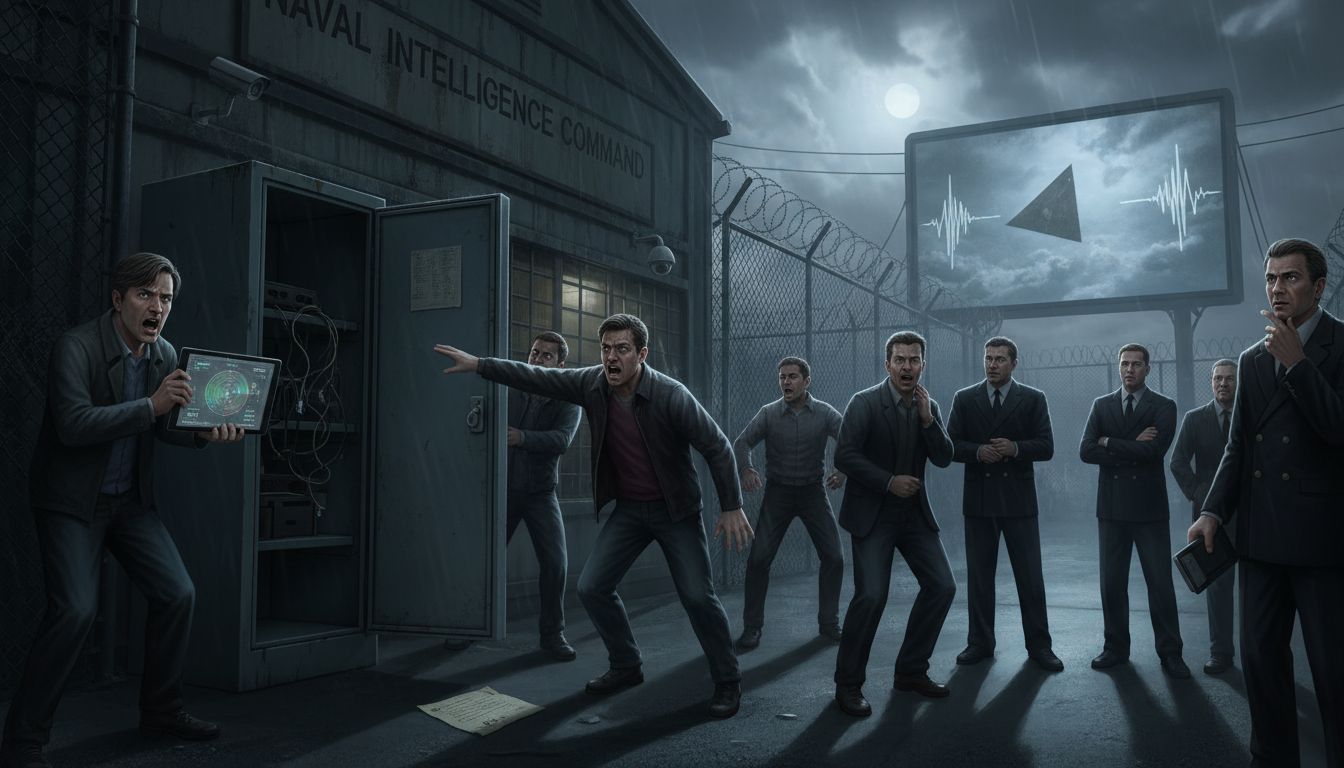
Witnesses to the 2004 encounter off the coast of Southern California say the Navy’s own high‑resolution radar and sonar recordings of the “Tic‑Tac” shaped object have inexplicably disappeared, fueling renewed accusations of a systematic cover‑up. Former pilots and ship‑board technicians who were present when the unidentified aerial phenomenon (UAP) was tracked by the carrier strike group say the data were transmitted to a naval base in San Diego shortly after the sighting, only to be “lost” when they later requested access. “We were told the tapes were missing, and that no one could locate them,” said one senior flight officer, who asked to remain anonymous for fear of repercussions. The officer added that the loss was not explained beyond a vague “administrative error.”
The original encounter, which took place in November 2004, involved multiple F/A‑18 Super Hornets from VFA‑41 and the USS Nimitz’s air‑search radar detecting an object that displayed extraordinary acceleration, lack of conventional propulsion signatures and a distinctive “Tic‑Tac” shape. The pilots’ infrared video, released by the Pentagon in 2017, showed a white, oblong craft moving against a clear sky, while the ship’s AN/SPY‑1 radar reportedly recorded a series of rapid, high‑altitude maneuvers. At the time, the Department of Defense classified the event as “unexplained” and later included it in the 2021 Office of the Director of National Intelligence (ODNI) report on UAPs, which acknowledged that the data “remain inconclusive” but did not address the whereabouts of the raw recordings.
According to the witnesses, the missing data were part of a larger packet of electronic surveillance that had been forwarded to the Naval Information Warfare Center (NIWC) for analysis. The packet, they claim, included not only the radar tracks but also sonar pings that captured anomalous acoustic signatures when the object hovered over the water. “The sonar showed a low‑frequency hum that didn’t match any known vessel,” one sonar technician recalled. When the team later filed a Freedom of Information Act request for the files, the Pentagon responded that the data “are not in our possession,” a statement that has been interpreted by some observers as an admission of loss, and by others as a possible deliberate suppression.
The Pentagon’s denial has reignited a broader debate about transparency in UAP investigations. In 2022, Congress mandated the establishment of the All‑Domain Anomaly Resolution Office (AARO), tasked with consolidating reports from the Air Force, Navy, and other agencies. Yet critics argue that the agency’s limited authority and the continued classification of key evidence hinder public confidence. “If the government truly wants to understand these phenomena, it needs to preserve and share the raw data,” said Dr. Leslie Kean, a journalist and researcher who has long advocated for open UAP inquiry. “The disappearance of such a pivotal data set undermines that goal.”
While the Navy has not provided a detailed account of how the files were handled, it has reiterated that all relevant information is being reviewed under the AARO’s oversight. The service’s spokesperson noted that “records management processes are subject to rigorous standards, and any loss would be investigated.” As the debate continues, the missing radar and sonar recordings remain a focal point for those demanding accountability, and they underscore the challenges of reconciling national security concerns with the public’s right to know about unexplained aerial incidents.