Overview
Wolfe Tone Square, a busy public space on Dublin’s Jervis Street, is built on ground with a long and troubled history — one that local ghost lore says has left a lingering mark. Before it became a park lined with benches, cafés and foot traffic, the site was home to St. Mary’s Church and Graveyard, and later a hospital where many died. According to the account published by Moon Mausoleum, the square’s past includes centuries of burial, overcrowding and redevelopment, making it one of those places where history and legend continue to overlap.
The graveyard’s transformation did not erase its earlier identity. The source notes that by the mid-1800s, the burial ground had become so overcrowded that remains were reportedly disturbed to create space for new interments. Even after the land was converted into a public park, burials allegedly continued there into the 1950s. That layered history is central to the square’s reputation: a modern urban setting resting atop a site associated with death, grief and memory.
The Ghost Story of John Toler
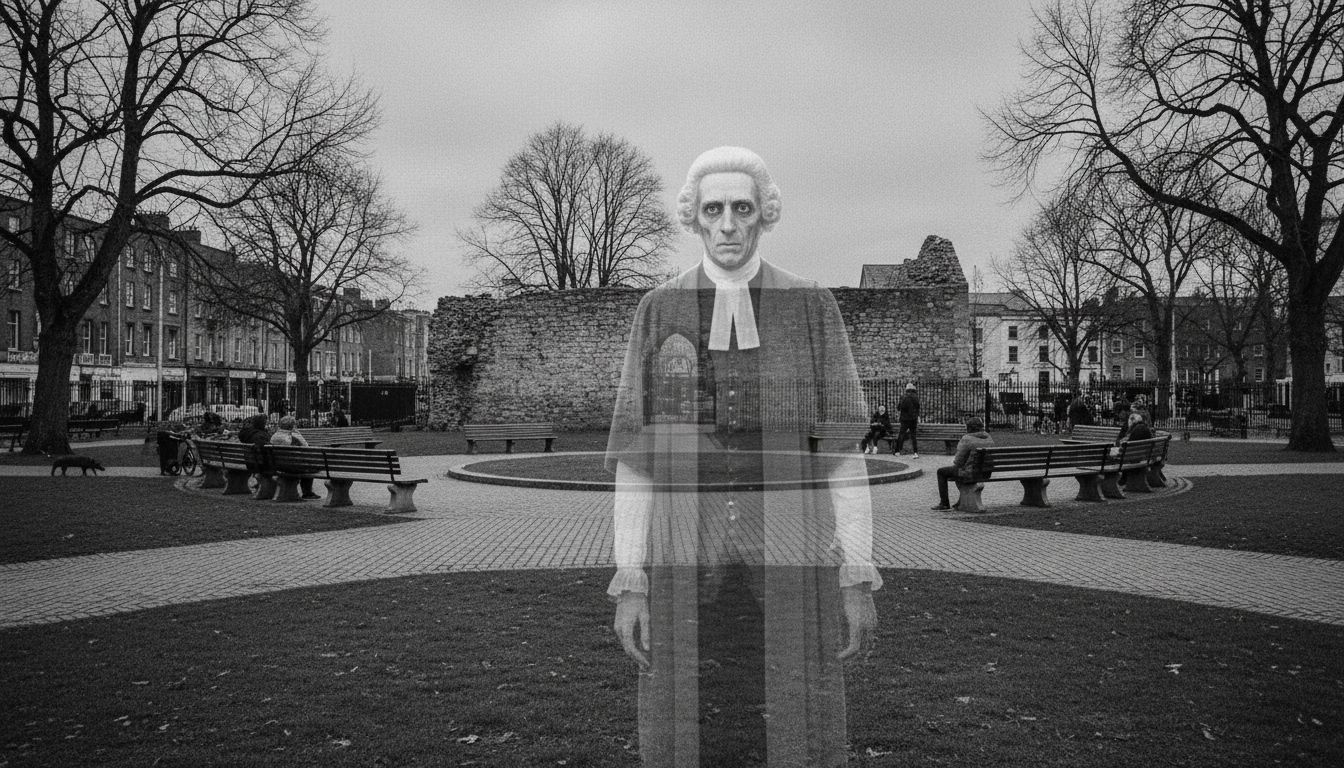
At the center of the haunting tradition is John Toler, 1st Earl of Norbury, better remembered in Irish history as the “Hanging Judge.” Toler served as Chief Justice of the Irish Common Pleas and developed a reputation for harsh, often controversial rulings. The source describes him as one of the most hated legal figures of his era, a judge who was said to deliver death sentences with unsettling indifference — even a smile.
Among the cases associated with his name is the hanging of a young man convicted of sheep stealing, a punishment widely viewed as excessive even by the standards of the time. Toler is also remembered for presiding over the trial and execution of Robert Emmet, the Irish revolutionary whose death made him infamous among those who opposed British authority in Ireland. In local folklore, that legacy of cruelty appears to have become inseparable from the idea that his spirit could not rest.
A Curse and a Restless Presence
The legend attached to Wolfe Tone Square says Toler’s fate was sealed by the widow of one of the men he condemned. Before her death, she is said to have placed a curse on him, condemning him to never find peace in death. When Toler died in 1831, his body was buried in St. Mary’s Graveyard — the same ground now beneath the square — but, according to the story, his spirit remained trapped there.
Reports and folklore surrounding the site describe Toler’s ghost as appearing in the form of a black dog, a familiar figure in many British and Irish haunting traditions. The source also mentions reports of eerie sounds in the area, adding to the square’s reputation as a place where the past still intrudes on the present. While such claims remain part of local supernatural tradition rather than verifiable fact, they continue to shape how the site is remembered.
Why the Square Still Draws Interest
Today, Wolfe Tone Square sits beside one of Dublin’s busiest commercial districts, yet its haunted reputation persists because its history is so visible beneath the modern landscape. The square also features public art, including “Ag Crú na Gréine” (“Enjoying the Sun”) by Jackie McKenna, a reminder of how urban spaces can be repurposed without fully shedding their past. For paranormal enthusiasts, the site offers a classic example of a former burial ground whose reputation has outlasted redevelopment.
Whether viewed as a ghost story, a historical cautionary tale or a reflection of Dublin’s layered memory, the legend of John Toler at Wolfe Tone Square endures because it connects a physical place to a moral one. The “Hanging Judge,” remembered for severity in life, is said in death to remain among the graves of those he condemned — a story that ensures this corner of Dublin continues to be associated not just with commerce and city life, but with unfinished business from the past.