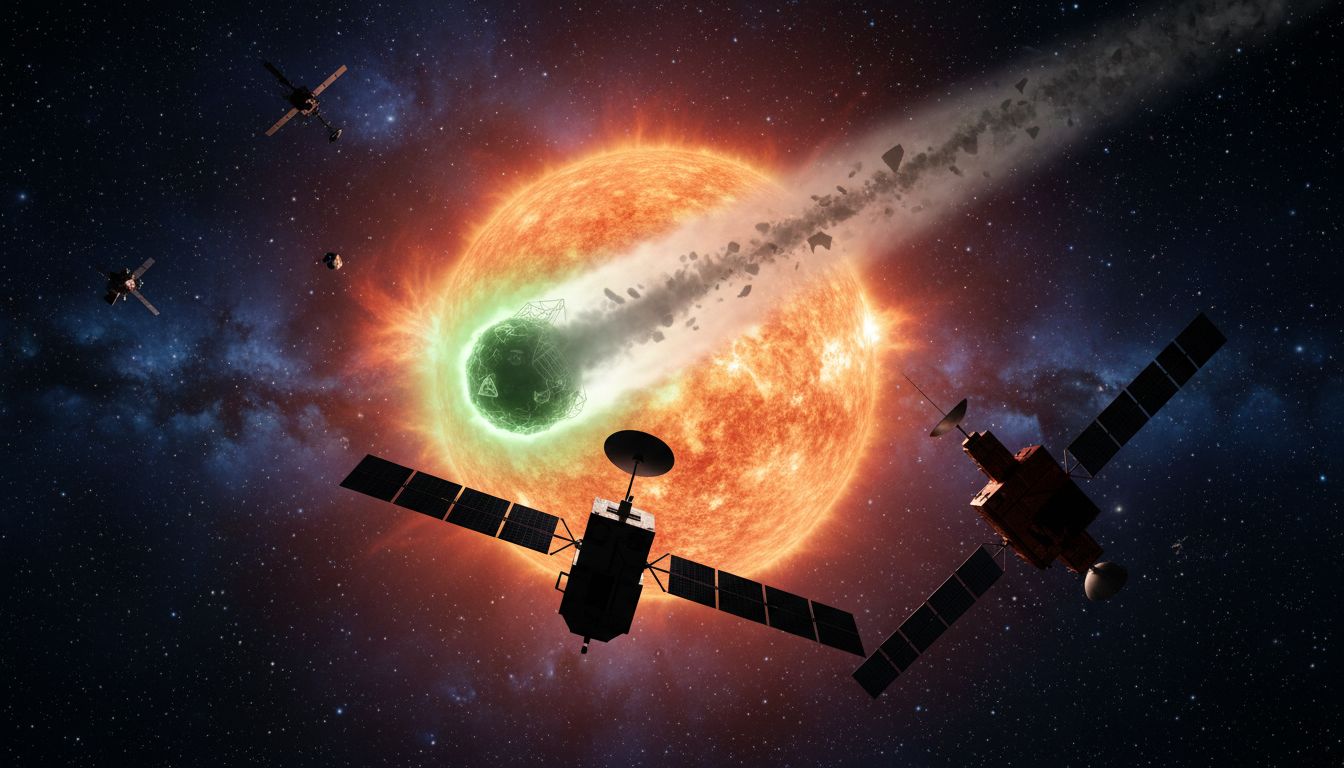
The interstellar comet designated 3I/ATLAS will reach its closest approach to the Sun—its perihelion—on 30 October 2025, but the event will unfold far beyond the reach of ground‑based telescopes. At a solar distance of roughly 0.04 AU (about 6 million kilometres), the comet will be lost in the Sun’s glare, rendering it invisible to the naked eye and to most Earth‑bound observatories. Instead, a fleet of space‑borne assets will monitor the object, offering a rare opportunity to study an interstellar visitor as it endures the Sun’s most intense radiation and particle environment.
The primary workhorse for the observation campaign will be NASA’s Solar and Heliospheric Observatory (SOHO), whose LASCO C2 and C3 coronagraphs have a long record of detecting sungrazing comets. SOHO’s wide‑field cameras can track objects down to a few solar radii from the Sun’s limb, and mission scientists expect to capture ATLAS’s brightening and possible fragmentation as it approaches perihelion. “SOHO has observed over 4,000 comets in its lifetime, but only a handful have been interstellar,” said Dr. Elena Martínez, a senior researcher at the Smithsonian Astrophysical Observatory. “This will be a test of our ability to extract compositional clues from a target that is both faint and fleeting.”
European and American spacecraft will complement SOHO’s view. ESA’s Mars Express, currently orbiting the Red Planet, will point its optical navigation camera toward the Sun‑ward side of its orbit, providing a different phase angle that could reveal the comet’s dust tail morphology. Meanwhile, NASA’s Parker Solar Probe and the European Solar Orbiter, both in close solar orbits, will collect in‑situ measurements of the solar wind and magnetic field conditions that ATLAS will encounter. “By correlating the plasma environment measured by Parker and Solar Orbiter with any changes we see in the comet’s brightness, we can infer how interstellar ices respond to extreme heating,” explained Dr. Michael Liu, a heliophysics specialist at the Johns Hopkins Applied Physics Laboratory.
The scientific stakes extend beyond solar physics. Interstellar objects (ISOs) have been recorded only three times since 2017: the enigmatic ‘Oumuamua, the chemically rich comet 2I/Borisov, and now 3I/ATLAS. Each has challenged assumptions about the composition and formation of planetary systems beyond the Sun. ATLAS’s trajectory—entering the inner solar system at a hyperbolic excess speed of about 35 km s⁻¹—suggests it originated from a star system with a relatively low ejection velocity, potentially preserving primordial ices. Spectroscopic data gathered by the European Space Agency’s BepiColombo, currently en route to Mercury, may detect signatures of water, carbon monoxide, or more exotic volatiles. “If we see a composition markedly different from solar system comets, it could point to distinct chemical pathways in other stellar nurseries,” noted Prof. Aisha Patel of the University of Cambridge’s Department of Astronomy.
The observations also intersect with ongoing discussions about unidentified aerial phenomena (UAP), as some fringe groups have speculated that interstellar visitors could be artificial probes. While the scientific community remains cautious, the data from ATLAS will provide a concrete baseline for what a natural interstellar comet looks like under extreme solar heating. “We need rigorous, peer‑reviewed measurements to separate fact from conjecture,” said Dr. Robert Hayes of the SETI Institute. “If ATLAS behaves as expected for a volatile‑rich body, it will reinforce the natural explanation and help focus future searches for any truly anomalous signatures.”
In sum, the perihelion passage of 3I/ATLAS will be a coordinated, multi‑instrument effort that leverages decades of solar observation experience. By capturing the comet’s light curve, tail development, and interaction with the solar wind, scientists hope to refine models of interstellar material and improve detection strategies for the next ISO. Although the comet will remain hidden from Earth’s sky, the data streamed back by SOHO, Mars Express, Parker Solar Probe, Solar Orbiter, and other spacecraft promise to illuminate one of the most compelling mysteries of modern astronomy.


