Overview
A resurfaced account from Birkenhead, near Bidston Hill in the U.K., is drawing renewed attention for its unusual blend of UFO-style observation, folklore, and summer superstition. The story, discussed in a recent Substack essay by Susan Demeter and attributed to a report originally relayed by researcher Albert S. Rosales, describes two painters who said they saw three distant objects in the sky in June 1982 and later believed they were looking at women riding broomsticks. While the account is extraordinary, it remains an anecdotal witness report rather than a verified incident, and it sits squarely at the intersection of paranormal lore and unexplained aerial phenomena.
The 1982 Birkenhead account
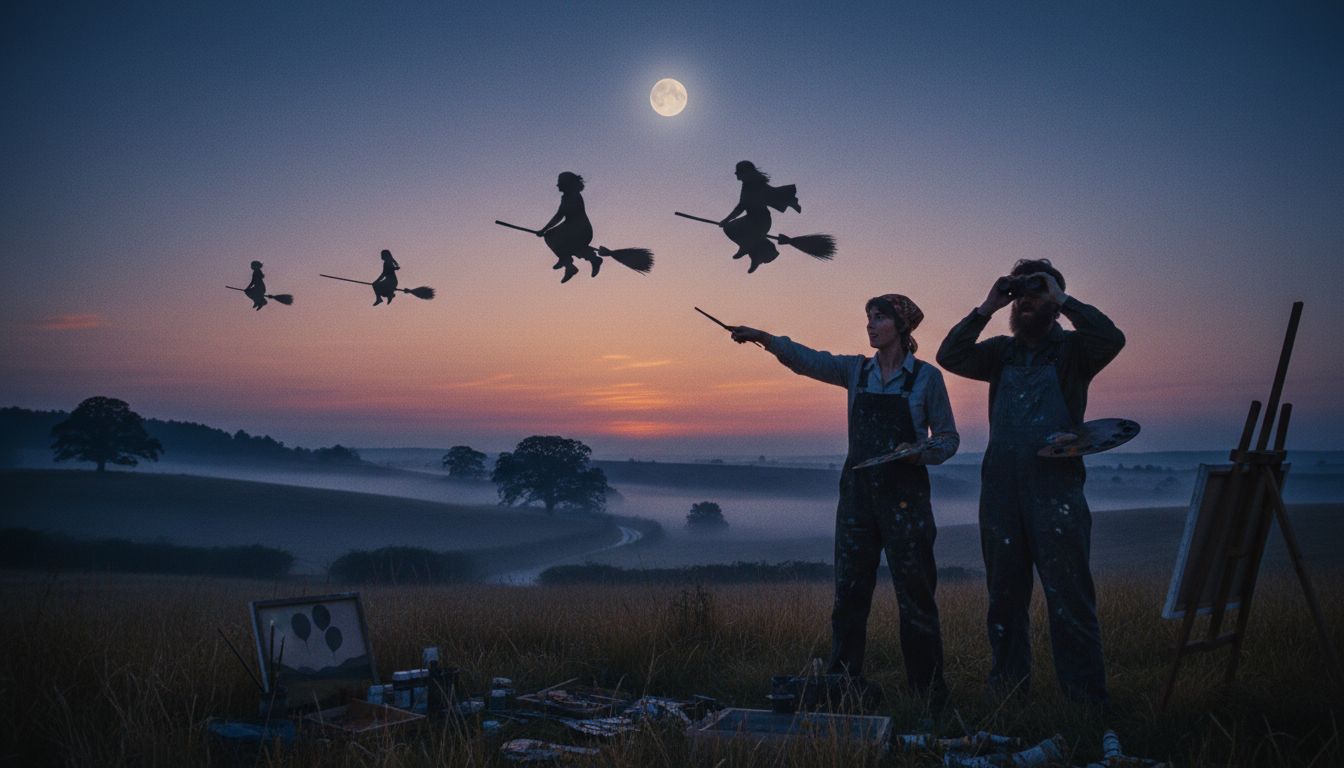
According to the retelling, the incident took place during a period of unusually hot weather while two men were working on the roof of an office building. One witness, identified as Dominic Bassett, a 17-year-old apprentice, said both men were startled after hearing what sounded like female screams and laughter coming from above them. When they looked up, they initially saw nothing unusual. Moments later, the sounds were heard again, this time apparently from a different direction, prompting the men to turn toward the Liverpool skyline, where they noticed three distant objects at significant altitude.
At first, Bassett’s colleague, identified only as Eric, reportedly thought the objects might be balloons, a plausible explanation given the hazy conditions and the distance involved. But the account becomes stranger as the objects allegedly moved closer, at which point the witnesses said they appeared to be women mounted on broomsticks. The source material does not provide the original testimony in full, and the description is presented as a paraphrased retelling, but the core claim is consistent: what began as a mundane skywatching moment developed into a classic “witch sighting” narrative.
Folklore, weather, and a “witch scare” summer
Demeter frames the incident in seasonal and folkloric terms, noting that the story carries a “lighthearted trickster vibe” associated with the start of summer and the approach of Midsummer’s Eve. The essay also suggests that the Birkenhead report was not isolated in the memory of locals; rather, it resurfaced alongside other recollections of a “witch scare” that summer. That broader context matters, because unusual weather, collective anticipation, and preexisting folklore can shape how people interpret ambiguous sights and sounds, especially in moments of stress or surprise.
The post also underscores a familiar challenge in anomalous-phenomena reporting: distinguishing between a genuine unexplained event and a perception influenced by environment, expectation, or misidentification. The author explicitly references pareidolia elsewhere in the essay, acknowledging how easily the human mind can impose familiar forms on uncertain visual input.
Another strange clip from Argentina
Alongside the historical British report, the piece also mentions a separate online video from Argentina showing a night-time figure walking in an odd, unstable manner. The clip has prompted speculation about whether the person is behaving like a shapeshifter or something more mysterious, but the more grounded explanation offered is that the figure could simply be extremely intoxicated. That caution is important: videos of anomalous-looking movement often circulate without context, and what appears uncanny at first glance can have an ordinary explanation once the setting is known.
Why these stories endure
Together, the Birkenhead account and the Argentina clip illustrate why UFO and high-strangeness stories remain compelling. They mix ambiguous evidence, vivid human testimony, and cultural memory, making them hard to dismiss outright but equally hard to confirm. In both cases, the strongest conclusion is not that the events prove a supernatural presence, but that people continue to encounter phenomena they cannot immediately explain—and, in the absence of certainty, folklore often fills the gap.