Overview
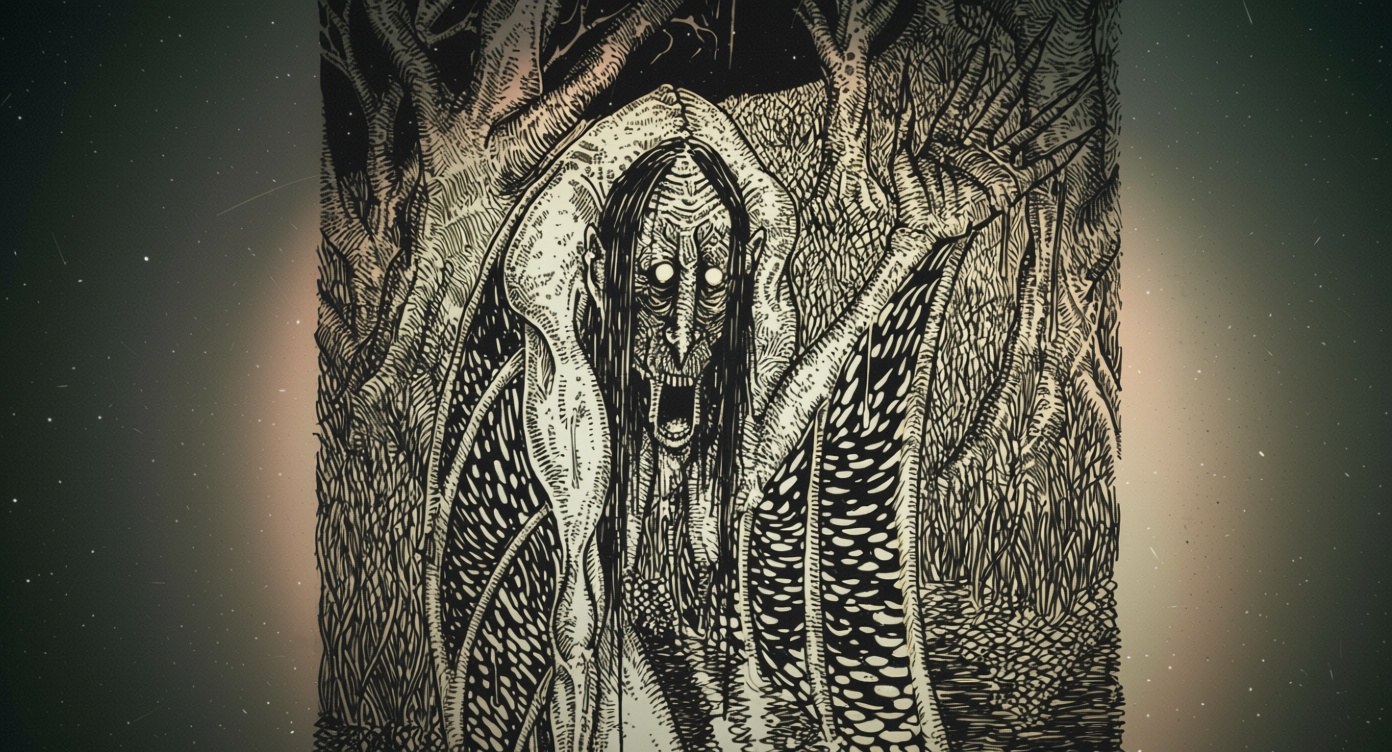
Across Thailand, Cambodia, Laos, and parts of Malaysia, the Krasue remains one of Southeast Asia’s most enduring and unsettling folk legends. Described as a floating, disembodied female head with its internal organs trailing beneath it, the spirit is said to roam rural areas at night in search of food and blood. While the details vary from place to place, the core image is remarkably consistent: a nocturnal being suspended between the human and supernatural worlds, feared for its hunger and its ability to move unseen through villages and fields.
Origins in Folklore and Fear
The origins of the Krasue differ depending on local tradition, but many accounts trace the spirit to a woman who died violently, was cursed, or became transformed through forbidden knowledge or ritual wrongdoing. In some tellings, she is reborn after death as a phut, a spirit forced to survive on wasted, uncooked, or rotten food. Other versions describe a wealthy woman protected from the sun by black gauze or ribbon around her head and neck, only to become possessed and cursed. One of the most common narratives involves black magic: a woman attempting a spell incorrectly, causing her head and body to separate. In those stories, the curse can extend through family lines, affecting daughters or granddaughters as well.
How the Spirit Is Described
Traditional descriptions portray the Krasue as a young, beautiful woman by day and a glowing, floating apparition by night. In some regions, she is also imagined as an older woman, but the visual symbolism stays the same: a face hovering in the darkness, faintly luminous like a lantern or will-o’-the-wisp. Beneath the head, the legend says, hang the lungs, stomach, and other organs, suspended from the neck as she drifts through the night. Modern retellings often give her pointed fangs, reinforcing comparisons to vampires, though local lore treats her as something distinct: a restless spirit driven by hunger rather than a classical bloodsucker.
A Predator of Night and Flesh
According to the legend, the Krasue hides in plain sight during the day, appearing ordinary and sometimes merely tired, before separating from her lower body at night to hunt. She is said to seek rotting meat, animal blood, and human blood, with livestock often listed among her victims. In more fearsome variants of the story, she is especially drawn to sleeping villagers, children, and the wounded, able to detect blood and open injuries from the air. That predatory element has helped make the Krasue one of the region’s most chilling supernatural figures, blending ideas of curse, witchcraft, bodily separation, and nocturnal danger into a single folkloric image.
A Persistent Regional Legend
Like many ghost stories, the Krasue reflects more than fear of the supernatural. It also embodies anxieties about illness, death, hidden transgression, and the vulnerability of rural life after dark. Its persistence across multiple countries suggests a shared cultural memory that has evolved over generations, while remaining locally meaningful. Whether told as warning, moral lesson, or village nightmare, the Krasue continues to occupy a powerful place in Southeast Asian folklore — a haunting reminder of how deeply stories of the unseen can shape everyday life.