Overview
In Colombian folklore, La Patasola stands out as one of the most haunting figures in the country’s wilderness traditions: a one-legged vampiric woman said to stalk forests, mountains, and remote jungle paths. As described in Moon Mausoleum, the entity is not merely a monster of fright but a warning figure, associated with the dangers of venturing too deeply into wild land or acting against it. The name itself translates to “the one-legged woman,” and the legend has endured for generations in rural communities where stories of the Patasola function as both cautionary tale and cultural memory.
The figure is often invoked with a protection chant that underscores her place in local belief. One version included in the source material implores: “Patasola, do no harm / for your good is in the mountains.” Such phrases point to the dual nature of the myth: La Patasola is feared as a predator, but she is also treated as a presence tied to the land itself, bound to the forests she is said to guard.
How the legend is told
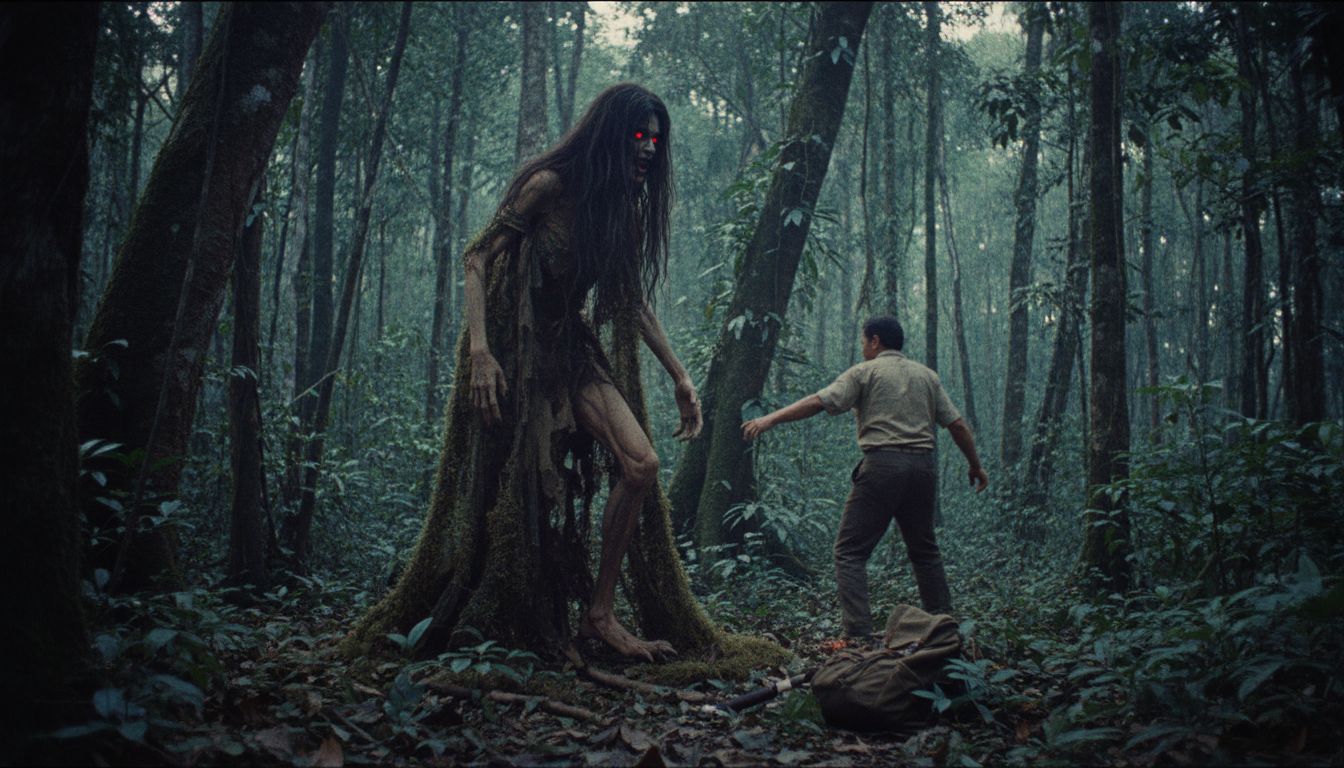
Accounts of La Patasola commonly begin the same way: she appears as a beautiful woman alone in the wilderness, where she catches the attention of hunters, loggers, miners, or wandering men. In many retellings, she mimics someone familiar—a lover, a wife, or a lost traveler—drawing the victim away from companions and into increasingly isolated terrain. Only after the victim is fully separated does the illusion collapse.
The transformation is central to the horror of the story. Once revealed, La Patasola is described as grotesque and unnatural, with only one leg, often ending in a hoof-like appendage, yet moving with remarkable speed through difficult ground. Folkloric descriptions vary, but she is frequently portrayed with tangled hair, bulging eyes, oversized fangs, and animal-like features. Some accounts say she can shift into a black dog or cow, while others emphasize her ferocity in attacking with claws or fangs, drinking blood, or devouring flesh in a manner that gives the legend a distinctly vampiric quality.
Origins shaped by morality and violence
Like many folk monsters, La Patasola’s origins are not fixed. The story changes depending on who is telling it and what lesson they want to emphasize. A common version presents her as a woman punished for immorality or betrayal—sometimes a cruel temptress, sometimes an unfaithful wife whose affair led to tragedy. In some accounts, her lover is killed and she is mutilated, leaving her to die and return as a forest spirit. Other versions describe her as a woman attacked with an axe, her leg severed and thrown into fire, with her death transforming her into a vengeful presence.
These conflicting backstories reflect the broader function of the myth. La Patasola is often framed as a punishment narrative, but also as a symbol of violence against women, betrayal, and the consequences of human wrongdoing. That ambiguity helps explain her staying power: she is at once a monster, a victim, and a warning.
A guardian of the wild
Beyond the gruesome imagery, La Patasola serves a practical cultural role. In the source material, she is described as a being who lures away those threatening to harm the forests. That places her in the tradition of guardian spirits—figures that protect nature by punishing intrusion, exploitation, or disrespect. In rural settings, stories like hers have long helped reinforce caution around dangerous terrain, especially among people working in isolated and physically hazardous environments.
In that sense, La Patasola is more than folklore horror. She represents a relationship between people and place, where the wilderness is not empty but inhabited, watched, and defended. The legend’s continued circulation suggests that even today, the one-legged woman remains a potent symbol of the Colombian wilds: feared, respected, and impossible to fully leave behind.