Overview
A weekend camping trip in Idaho’s remote Payette National Forest turned into a bizarre encounter that has reignited public debate over the existence of large‑footed cryptids. Two teenagers, ages 16 and 17, reported a series of unexplained sounds—whistling, snapping branches and a rhythmic knocking—followed by a visual sighting of a nine‑foot, dark‑fur figure with reflective eyes. The teens later claimed that several similar beings surrounded their campsite before they fled. While state investigators have confirmed the teens’ statements as “consistent and truthful,” they stopped short of labeling the phenomenon anything more than “unexplained.”
Incident Details
According to the teenagers’ account, the group set up camp near the South Fork of the Payette River on Saturday night. Around 02:30 a.m. they heard a high‑pitched whistling that seemed to move through the trees, accompanied by the sound of branches snapping under an unseen weight. Within minutes, a steady “knocking” rhythm echoed from the surrounding woods. The campers described the noise as “almost like a drumbeat, but irregular.”
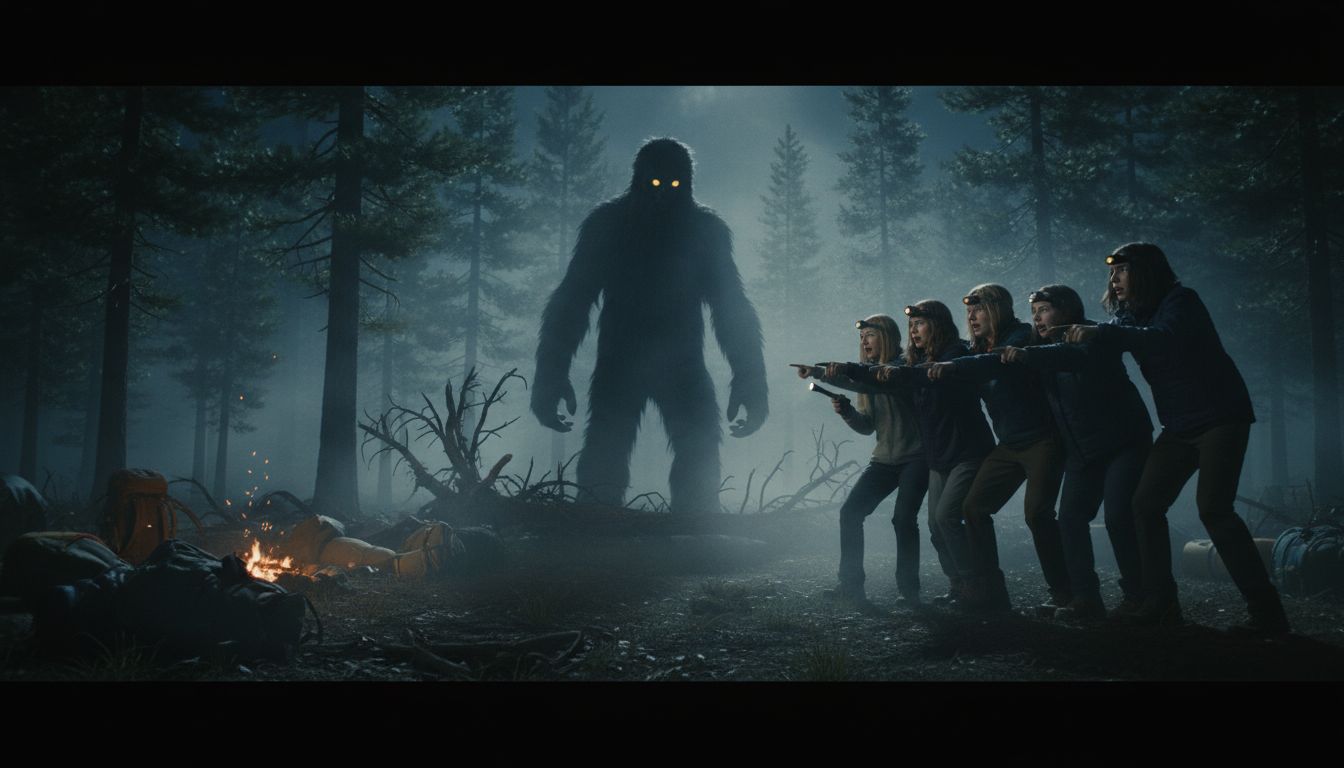
At approximately 03:10 a.m., the teens claimed they saw a large, upright figure emerging from the darkness. One described it as “about nine feet tall, covered in dark, matted fur, and its eyes reflected like polished steel.” The creature reportedly stood a few meters from the tent before retreating. Minutes later, the teens said additional silhouettes appeared, forming a loose circle around the campsite. Fearful, the group fired a single warning shot from a rifle they carried for wildlife protection; the shot missed, and the figures vanished.
The pair reported the incident to the Payette Ranger District the following morning, providing a detailed written statement and a short video of the campsite’s perimeter, though the footage captured no clear image of the alleged beings.
Investigation Findings
The Idaho State Police, in coordination with the U.S. Forest Service, conducted a preliminary investigation. Officers interviewed the teenagers, their parents, and the campsite’s supervising adult, finding no contradictions in their narratives. “Their accounts were consistent, and there were no signs of hoaxing or external influence,” said Lt. Maria Hernandez of the Idaho State Police.
Physical evidence was limited to disturbed vegetation and a series of shallow footprints measuring roughly 14‑inch strides, a size larger than typical elk or bear prints. A wildlife biologist from the Forest Service noted that “large mammals can create irregular patterns when moving through dense underbrush, especially at night,” but the footprints’ depth and spacing did not match known species. The investigation concluded with a classification of “Unexplained Phenomenon – No Immediate Threat.”
Historical Connections
The incident has drawn attention from a former Army sergeant, Mark “Mack” Donovan, who now heads the North American Cryptid Research Association (NACRA). Donovan recalled a 1993 training exercise in Oregon’s Cascade Range where his unit encountered “tall, dark‑fur silhouettes that emitted low‑frequency whistles and moved in coordinated patterns.” He believes the Idaho reports echo those earlier observations. “The auditory signatures and the coordinated movement are strikingly similar,” Donovan told the Gazette. He has offered to assist investigators by comparing the recent footprint impressions with those recorded during the 1993 event.
Donovan’s involvement adds a layer of credibility for some cryptid enthusiasts, while skeptics point out that anecdotal military accounts lack verifiable documentation.
Broader Implications
The Payette encounter underscores the challenges faced by law‑enforcement and wildlife agencies when confronting reports that sit at the fringe of mainstream science. Scientists emphasize the need for rigorous data collection, urging witnesses to preserve physical evidence and avoid premature conclusions. Meanwhile, the growing community of amateur researchers, bolstered by social‑media platforms, continues to compile sightings, hoping to establish a pattern that could prompt formal scientific study.
For now, the Idaho teenagers remain convinced they encountered something extraordinary, while officials maintain a cautious stance. As the forest’s canopy settles back into its usual quiet, the question persists: are these isolated incidents, misidentified wildlife, or a glimpse of an as‑yet‑undocumented species? The answer, if it ever arrives, will likely depend on future collaborations between investigators, researchers, and the public who venture into America’s wildest places.