Overview
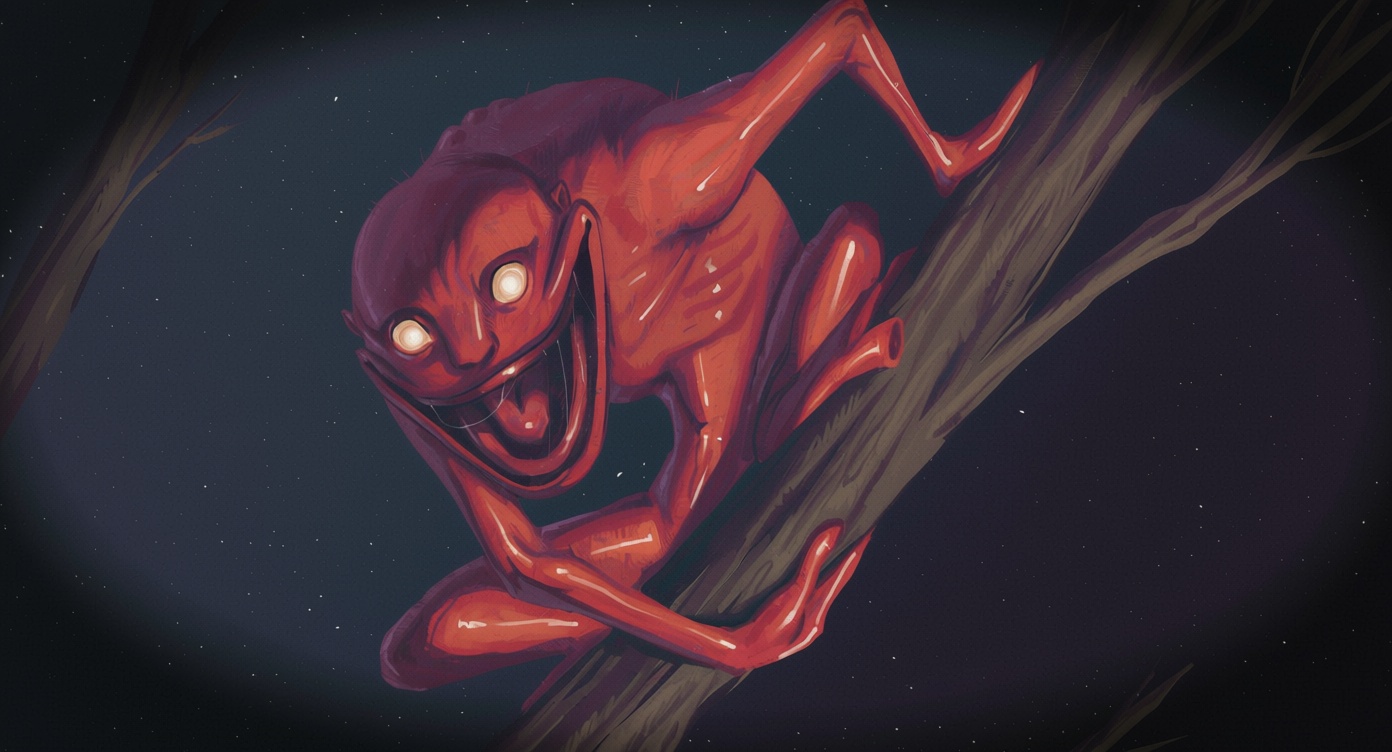
The Yara-ma-yha-who is one of the more unusual figures in Aboriginal folklore: a vampiric creature said to wait beneath Australian fig trees and strike in broad daylight rather than under cover of night. In the legend, the being is described as a small, red, frog-like humanoid with an oversized head, a toothless mouth, and sucker-like appendages on its hands and feet. Far from the gothic vampire of European fiction, this creature belongs to the harsh, sunlit landscape of the Australian bush, where shade under a fig tree can become a place of danger.
The creature’s story has been preserved in recorded versions of southeastern Aboriginal traditions, including accounts associated with David Unaipon, the pioneering Aboriginal writer and inventor whose work helped bring Indigenous stories to wider audiences. In those tellings, the Yara-ma-yha-who is not simply a predator but something stranger: a being whose feeding cycle is as unsettling as its appearance. It latches onto victims with its suckers, drains their blood, swallows them whole, and later regurgitates them alive.
The Legend
According to the legend, the Yara-ma-yha-who lies in wait in fig trees, where travelers may seek relief from the heat. Once a person rests beneath its branches, the creature drops down and attaches itself to the victim’s body, drawing blood through its hands and feet. What follows is a sequence that makes the story especially memorable: instead of killing outright, the creature swallows the person, drinks water, falls asleep, and eventually spits them back out.
The victim, however, does not return unchanged. Folk descriptions say they emerge shorter and redder after each encounter, with the process repeating until, after several attacks, they are transformed into another Yara-ma-yha-who. In this sense, the legend contains a disturbing cycle of imitation and inheritance, turning the victim into the very thing that preyed upon them. That transformation gives the story a cautionary quality common in oral traditions, where the supernatural often serves to mark the boundaries of behavior, danger, and survival.
Cultural Context
The Yara-ma-yha-who is closely tied to the broader framework of Dreamtime or Dreaming stories, which are central to Aboriginal worldview and cultural knowledge. These narratives connect people, land, ancestors, and law, and are often passed on through storytelling, art, ceremony, and song. In that context, the creature is not merely a monster for entertainment; it is part of a living cultural landscape in which stories carry meaning, memory, and instruction.
That distinction matters, especially when folklore is discussed outside Indigenous communities. The Yara-ma-yha-who is often presented in modern retellings as a “daylight vampire,” but that framing can flatten a much richer tradition. Aboriginal stories are deeply regional and varied, and the way they are recorded and retold has long been shaped by colonial collecting practices. Any account of the creature should therefore be handled with care, recognizing both its narrative power and its cultural origins.
Why the Story Endures
Part of the legend’s staying power is its vivid reversal of vampire mythology. Where Western vampires are typically associated with castles, moonlit nights, and aristocratic decadence, the Yara-ma-yha-who thrives in heat, daylight, and the everyday danger of the bush. Its grotesque features and bizarre feeding method make it unforgettable, but its real significance lies in how it reflects the environment and storytelling traditions from which it emerged.
In contemporary writing and popular culture, the Yara-ma-yha-who continues to attract attention because it sits at the intersection of folklore, horror, and cultural history. Yet its greatest interest may be that it challenges familiar monster stories: it is not a creature of imported Gothic darkness, but one rooted in the Australian landscape, where even the shade of a fig tree can become part of a cautionary tale.